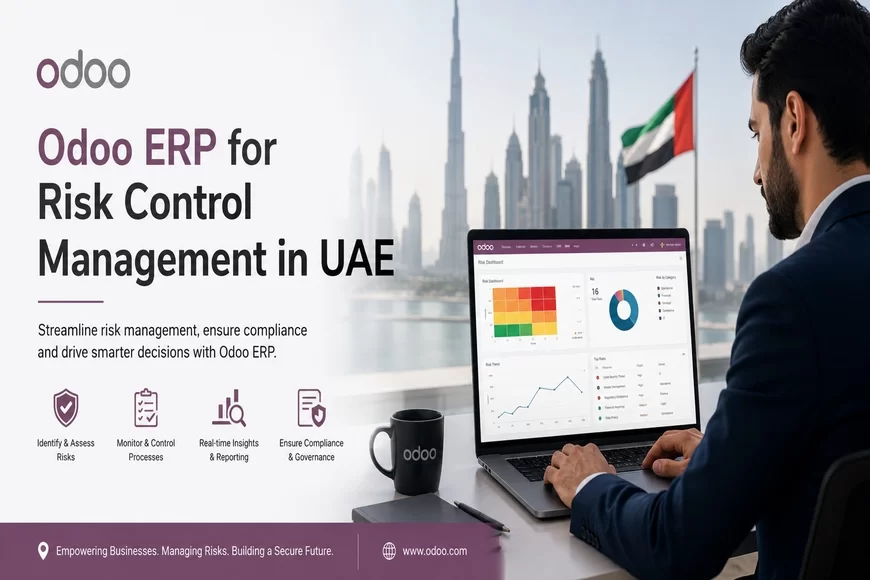
Odoo ERP for Risk Control Management in UAE
Strengthen rollout stability with Odoo ERP Risk Control for manufacturing. Reduce implementation risks, protect continuity, and improve adoption confidence.
 RIbsadmin
Odoo Manufacturing ERP Risk Control Framework
Reduce implementation uncertainty before it becomes operational disruption
ERP failures rarely begin at go-live. They begin earlier—through unclear ownership, uncontrolled scope changes, weak data governance, rushed approvals, and decisions made without operational validation. In manufacturing environments, these gaps create hidden pressure that later appears as downtime, reporting confusion, user resistance, and unstable execution.
A structured Odoo ERP risk control management helps manufacturers reduce uncertainty before it affects production continuity, inventory trust, costing visibility, or leadership confidence.
For manufacturers across Dubai, Abu Dhabi, and Sharjah, the goal is practical: protect operations while improving control.
Why Risk Control Matters in Manufacturing ERP Projects
Because uncontrolled projects create controlled-looking problems later
Manufacturing ERP implementations affect procurement, inventory, planning, production, quality, maintenance, finance, and reporting simultaneously. Without structured governance, small decisions create long-term operational instability.
- Finance & accounting: invoicing discipline and reporting confidence with Odoo Finance Process Applications
- Sales operations: pipeline clarity and order consistency with Odoo Sales Applications
- Supply chain: procurement and inventory accuracy with Odoo Supply Chain Applications
- HR & governance: standardised workflows and approvals with Odoo Human Resources Applications
- Services & delivery: accountability for projects and services using Odoo Services Applications
- Productivity & approvals: enforce ownership with Odoo Productivity Applications
What risk-controlled implementation protects
- Scope clarity: reduces uncontrolled customization and decision drift
- Data integrity: prevents reporting confusion caused by inaccurate migration
- Role accountability: approvals and responsibilities stay traceable
- Operational continuity: phased rollout reduces production disruption risks
- User adoption: structured testing improves confidence before go-live
Implementation foundation: Odoo Apps Implementation Services
High-Intent CTA (UAE Manufacturing)
The earlier risks are identified, the lower the recovery cost later
- Request a project risk assessment: Contact Us
- Validate rollout priorities and governance controls: Book a Demo
Core ERP Risk Areas Manufacturers Must Control
Operational stability depends on disciplined execution—not assumptions
- Scope expansion risk: uncontrolled additions increase complexity and delays
- Master data inconsistency: inaccurate BOMs, routings, or stock data affect reporting trust
- Process mismatch risk: undocumented workflows reduce adoption consistency
- User dependency risk: limited training creates reliance on a few individuals
- Integration instability: disconnected systems create visibility gaps
- Cutover risk: rushed transitions impact production continuity and inventory confidence
Supporting governance:
Odoo Software Consulting Services
Odoo Application Integration Services
Risk Control Structure During Implementation
Control points reduce surprises and improve decision confidence
- Discovery validation: confirm workflows, reporting expectations, and operational constraints
- Fit-gap governance: classify standard vs custom process requirements carefully
- Controlled migration: reconcile inventory, financial, and production data before cutover
- UAT discipline: validate execution under real operational scenarios
- Approval governance: role-based permissions reduce unauthorized changes
- Hypercare monitoring: stabilize issues early before they affect adoption momentum
Manufacturing-Specific Risks That Need Attention
Factories carry operational pressure that generic ERP projects often underestimate
- Production downtime during transition
- Inventory variance after migration
- Incorrect costing structures affecting margin reporting
- Weak traceability during quality investigations
- Unclear approval ownership across departments
- Resistance from shop-floor users under production pressure
These risks are reduced through phased rollout discipline, validation checkpoints, controlled approvals, and operational testing before full deployment.
Governance Approach Used by RIBS Technologies
Structured delivery reduces uncertainty and improves adoption confidence
RIBS Technologies is an ISO 9001:2015-certified software development company supporting UAE manufacturers with governance-focused ERP implementation practices.
Governance principles applied
- Defined ownership: clear responsibility across departments and stakeholders
- Controlled customization: reduce long-term maintenance instability
- KPI-based visibility: measurable checkpoints during rollout
- Role-based enablement: teams trained around execution responsibilities
- Continuous stabilization: phased optimization after go-live
Operational proof and industry exposure:
Clients
Operational Controls That Strengthen Stability
Reliable systems reduce decision hesitation
- Approval workflows for procurement, finance, and production changes
- Structured access permissions aligned to accountability
- Barcode and traceability validation before live inventory movement
- Reporting reconciliation before financial closure
- Controlled workflow automation to reduce manual dependency
Related services:
Odoo Apps Workflow Automation Services
Odoo Apps Support and Maintenance Services
CTA Block - Odoo Manufacturing ERP Risk Control Framework
ERP success is not built on speed alone—it is built on controlled execution
- Book a demo: Request Demo
- We are the certified: Odoo ERP Partner
- To know more: About RIBS
- Customers who got benified by us: Clients
FAQs - Odoo Manufacturing ERP Risk Control Framework
Q1: Why is risk control important during ERP implementation?
A: Risk control helps reduce disruption caused by poor data quality, unclear workflows, weak governance, and rushed deployment decisions that later affect operations and reporting.
Q2: What is the biggest risk in manufacturing ERP projects?
A: Common risks include inaccurate master data, uncontrolled customization, weak user adoption, inventory variance, and operational disruption during cutover.
Q3: How does phased implementation reduce ERP risk?
A: A phased rollout improves validation, stabilizes adoption, and reduces pressure on production teams before expanding to additional workflows or sites.
Q4: Does risk control include user access governance?
A: Yes. Role-based permissions and approval structures help reduce unauthorized changes and improve accountability across departments.
Q5: What happens after go-live?
A: Post-go-live hypercare helps stabilize workflows, resolve adoption issues, validate reporting accuracy, and improve operational confidence.