Odoo Manufacturing ERP Success Stories UAE
Explore Odoo Manufacturing ERP Success Stories and discover how manufacturers improve visibility, control, quality, inventory accuracy, and decision-making.
 RIbsadmin
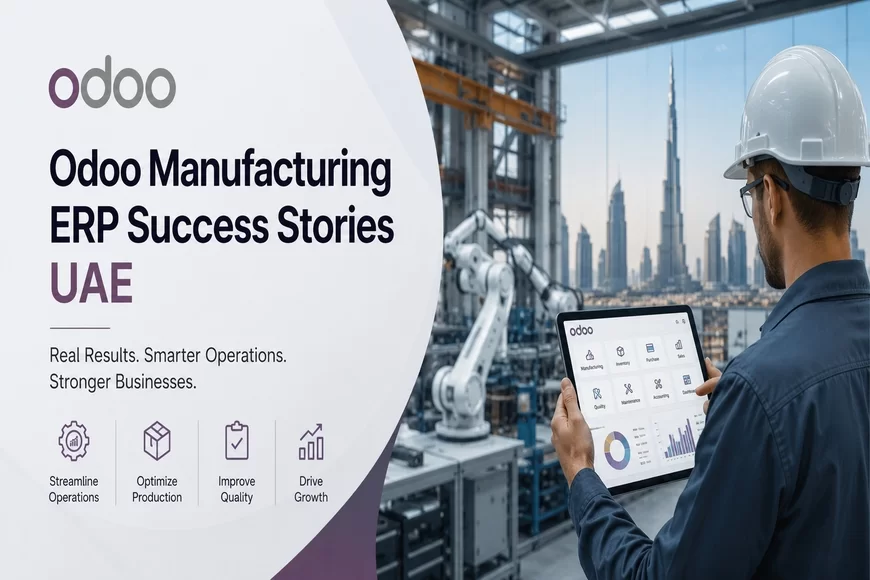
Odoo Manufacturing ERP Success Stories
Real operational improvements begin when visibility becomes accountability
Every successful ERP journey starts with a common realization: growth becomes difficult when decisions depend on disconnected data, manual follow-ups, and inconsistent execution. Manufacturers that adopt Odoo Manufacturing ERP often pursue the same objective—greater control over production, inventory, quality, maintenance, and costing.
This page highlights the types of operational challenges manufacturers commonly address and the measurable improvements they often target through a structured ERP transformation.
Why Manufacturing Success Stories Matter
Because confidence grows when outcomes become visible
Manufacturing leaders rarely invest in ERP for software alone. They invest to reduce uncertainty, strengthen governance, and improve execution consistency.
Success stories help answer critical questions:
- Can production become more predictable?
- Can inventory accuracy improve across warehouses?
- Can quality processes become more disciplined?
- Can maintenance become proactive instead of reactive?
- Can costing become more transparent and reliable?
Explore the foundation:
Odoo Manufacturing ERP Solutions
What Manufacturers Commonly Achieve
Organizations implementing Odoo Manufacturing ERP often focus on improving:
- Production visibility through structured planning and work order management
- Inventory integrity with barcode, lot, and serial traceability
- Quality governance through standardized inspections and evidence capture
- Maintenance reliability through preventive maintenance programs
- Cost control through improved consumption and variance visibility
- Management reporting through unified operational dashboards
While outcomes vary by organization, the goal remains consistent: replace assumptions with operational facts.
Common Transformation Themes
Before ERP
- Information scattered across spreadsheets and systems
- Delayed reporting and limited operational visibility
- Reactive decision-making
- Manual approval bottlenecks
- Inconsistent data across departments
After Structured ERP Adoption
- Shared operational data across teams
- Faster reporting cycles
- Improved process accountability
- Better traceability and governance
- More confident decision-making
Supporting capabilities:
Odoo Supply Chain Management Software
Odoo Finance Accounting Solutions
Success Areas Across Manufacturing Operations
Production Management
- Improved planning discipline
- Better work order visibility
- Stronger schedule adherence
Inventory & Warehousing
- Reduced stock discrepancies
- Improved traceability
- Faster inventory transactions
Quality Management
- Standardized inspection processes
- Improved defect visibility
- Better compliance readiness
Maintenance Management
- Preventive maintenance scheduling
- Improved asset visibility
- Reduced unexpected downtime risk
Financial Control
- Better operational costing visibility
- Improved variance analysis
- Stronger reporting consistency
How Success Is Typically Measured
Manufacturers commonly monitor:
- Inventory accuracy
- Production adherence
- Quality non-conformance trends
- Downtime frequency
- Order fulfillment performance
- Cost variance visibility
- User adoption levels
The most sustainable improvements usually occur when technology, process governance, and user adoption progress together.
Implementation Approach Behind Successful Outcomes
Successful ERP programs are rarely driven by software alone.
They are typically supported by:
- Clear discovery and process mapping
- Defined KPIs and governance controls
- Structured user training
- Controlled data migration
- Phased rollout planning
- Post-go-live stabilization
Implementation services:
Odoo Apps Implementation Services
Odoo Software Consulting Services
Why RIBS Technologies
RIBS Technologies is an ISO 9001:2015-certified software development company helping organizations strengthen operational visibility, governance, and ERP adoption across the UAE.
Core Odoo Manufacturing Services
Choose the service layer that strengthens operational control first
- Odoo Consulting: Define workflows, controls, KPIs, and rollout priorities: Odoo Software Consulting Services
- Odoo Implementation: Configure modules, roles, approvals, and reporting structure: Odoo Apps Implementation Services
- Odoo Customization: Extend features without destabilizing the system: Odoo Application Customization Services
- Odoo Integration: Connect data flows across business systems: Odoo Application Integration Services
- Workflow Automation: Reduce delays with controlled automation: Odoo Apps Workflow Automation Services
- Analytics and Reporting: Build KPI reporting that drives action: Odoo Apps Analytics and Reporting Services
- Support and Maintenance: Protect uptime, ad option, and controlled improvements: Odoo Apps Support and Maintenance Services
Learn more:
CTA Block (Dubai, Abu Dhabi & Sharjah)
The fastest way to reduce uncertainty is to create visibility
- Book a consultation: Contact RIBS Technologies
- We are the certified: Odoo ERP Partner
- To know more: About RIBS
- Customers who got benefits from us: Clients
FAQs - Odoo Manufacturing ERP Success Stories
Q1: What types of manufacturers benefit from Odoo Manufacturing ERP?
A: Odoo supports various manufacturing environments including discrete, batch, process, make-to-order, and multi-site operations.
Q2: Are success stories focused only on technology improvements?
A: No. Most successful ERP initiatives combine technology, process governance, data quality, and user adoption.
Q3: What KPIs are commonly tracked after implementation?
A: Organizations often monitor inventory accuracy, production performance, quality metrics, downtime, and costing visibility.
Q4: How long does it take to see operational improvements?
A: Timelines vary based on scope, readiness, adoption, and implementation approach. Improvements are typically measured in phases.
Q5: Why review manufacturing success stories before selecting an ERP?
A: They help decision-makers understand common challenges, implementation considerations, and potential operational outcomes.