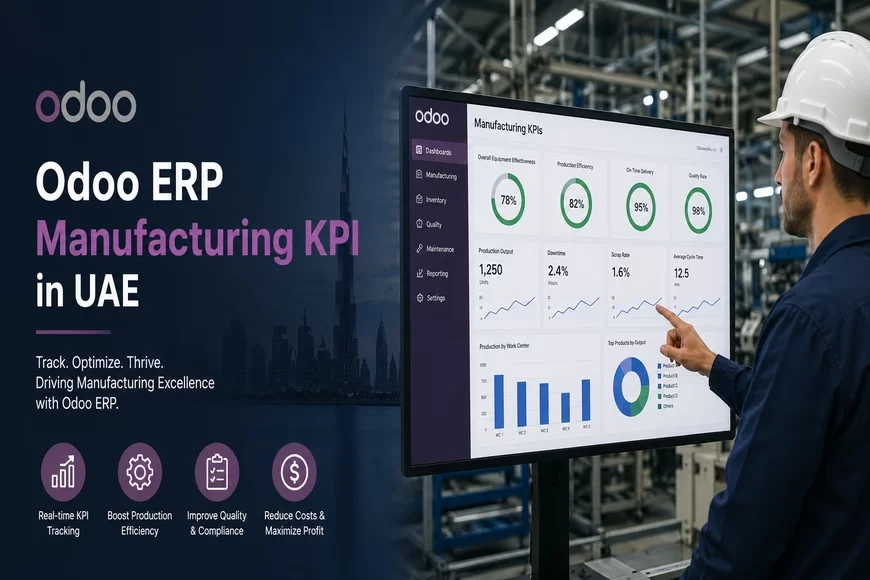
Odoo ERP Manufacturing KPI in UAE
Define Manufacturing KPI Definition frameworks in Odoo ERP to improve visibility, accountability, and operational reporting across UAE factories.
 RIbsadmin
Manufacturing KPI Definition in Odoo ERP
Measure what protects margin, delivery, and operational stability
Many factories collect data every day—but still struggle to make confident decisions. The problem is rarely the lack of reports. It is the lack of aligned KPIs. When departments track different priorities, execution becomes reactive, accountability weakens, and leadership loses visibility into what truly drives performance.
A structured KPI definition framework in Odoo Manufacturing ERP helps transform raw operational data into measurable control signals—so teams focus on the metrics that influence throughput, quality, inventory accuracy, downtime, and profitability.
For manufacturers in Dubai, Abu Dhabi, and Sharjah, KPI discipline creates something valuable: decision confidence under pressure.
Why KPI Definition Matters in Manufacturing ERP
Because unmanaged metrics create unmanaged operations
Factories often fail to improve because teams optimize isolated activities instead of operational outcomes. KPI definition aligns departments around measurable business objectives and reduces confusion caused by inconsistent reporting logic.
What manufacturers gain through KPI alignment
- Clear operational visibility: standardized metrics across production, inventory, maintenance, and finance
- Faster management decisions: trusted data reduces debates and approval delays
- Accountability with evidence: ownership becomes measurable, not assumption-based
- Better process discipline: teams work toward common operational targets
- Margin protection: KPI-driven visibility exposes waste earlier
Explore the operational foundation:
Odoo Manufacturing ERP
High-Intent CTA (UAE)
If performance cannot be measured clearly, it cannot improve consistently
- Request a KPI workshop: align reporting with operational goals:
Book a Demo - Review reporting gaps: identify hidden inefficiencies and visibility risks:
Contact Us
Core Manufacturing KPIs Commonly Defined in Odoo
Track the indicators that influence execution quality
- Production KPIs: output, schedule adherence, OEE, cycle efficiency
- Inventory KPIs: stock accuracy, inventory turnover, shortage frequency
- Quality KPIs: rejection rate, rework %, NCR trends, yield variance
- Maintenance KPIs: downtime hours, MTBF, MTTR, maintenance compliance
- Financial KPIs: production cost variance, scrap cost, margin visibility
- Delivery KPIs: OTIF performance and dispatch adherence
Support connected reporting through:
Odoo Dashboards & KPI Services
How KPI Definition Works in Odoo Manufacturing ERP
Create measurable control—not dashboard overload
- Define operational objectives: identify what affects delivery, quality, and cost most
- Standardize data logic: ensure every department measures consistently
- Connect workflows to KPIs: production, inventory, quality, and finance aligned together
- Assign ownership: every KPI linked to responsibility and action paths
- Review trends continuously: monitor variance patterns before they become costly
Common KPI Challenges Manufacturers Face
Small reporting gaps often create large operational blind spots
- Teams tracking different spreadsheet versions
- Reports generated too late for corrective action
- Metrics without ownership or escalation paths
- Excess dashboards creating confusion instead of clarity
- Inconsistent costing and production visibility across departments
Odoo reduces these issues by centralizing workflows, transactions, and operational reporting inside one controlled system.
KPI Governance During ERP Implementation
Because reporting structure influences adoption quality
KPI definition is most effective when embedded during ERP implementation—not added later as an afterthought.
Structured delivery approach
- Discovery workshops: identify operational priorities and reporting expectations
- KPI mapping: connect business goals with measurable ERP data points
- Dashboard configuration: role-based reporting and approval visibility
- User alignment: train teams on interpretation and accountability
- Continuous refinement: optimize KPI relevance as operations evolve
Implementation support:
Odoo Apps Implementation Services
Connected Reporting Areas in Odoo
Cross-functional visibility improves decision quality
- Production and planning dashboards
- Inventory and warehouse reporting
- Quality and traceability visibility
- Maintenance performance tracking
- Finance and costing analysis
Integration and workflow planning:
Odoo Application Integration Services
Why KPI Discipline Improves ERP Adoption
Because people trust systems that create clarity
When KPIs are clear, employees understand expectations faster. This reduces resistance, improves accountability, and strengthens long-term ERP usage across departments.
Reliable operational reporting also reduces emotional decision-making during production pressure.
Why RIBS Technologies
Because reporting should support action—not overwhelm teams
RIBS Technologies is an ISO 9001:2015-certified software development company delivering structured ERP implementations focused on visibility, governance, and measurable outcomes.
- Finance & accounting: invoicing discipline and reporting confidence with Odoo Finance Process Applications
- Sales operations: pipeline clarity and order consistency with Odoo Sales Applications
- Supply chain: procurement and inventory accuracy with Odoo Supply Chain Applications
- HR & governance: standardised workflows and approvals with Odoo Human Resources Applications
- Services & delivery: accountability for projects and services using Odoo Services Applications
- Productivity & approvals: enforce ownership with Odoo Productivity Applications
Company profile and experience:
About RIBS Technologies
CTA - Manufacturing KPI Definition in Odoo ERP
Better KPIs create better operational behavior
- Book a demo: Request Demo
- We are the certified: Odoo ERP Partner
- To know more: About RIBS
- Customers who got benified by us: Clients
FAQs - Manufacturing KPI Definition in Odoo ERP
Q1: Why are KPIs important in manufacturing ERP?
A: KPIs help manufacturers measure operational performance consistently across production, inventory, quality, maintenance, and finance—improving visibility and decision-making speed.
Q2: Can Odoo provide real-time manufacturing dashboards?
A: Yes. Odoo supports role-based dashboards and reporting views that help management monitor operational trends and exceptions more effectively.
Q3: Which manufacturing KPIs are most commonly tracked?
A: Common KPIs include OEE, schedule adherence, rejection rate, downtime, inventory accuracy, OTIF delivery, and production cost variance.
Q4: When should KPI definition happen during ERP implementation?
A: KPI planning is most effective during the discovery and solution design phase, where reporting logic and business objectives are aligned early.
Q5: Can KPI dashboards be customized by department?
A: Yes. Dashboards can be configured based on operational roles, reporting priorities, and management visibility requirements.