How Odoo Helped a Factory to Adopt Lean Manufacturing Processes
Discover how Odoo Lean Manufacturing helped a UAE factory reduce waste, stabilize workflows, and improve flow, quality, and costing accuracy through disciplined execution.
 RIbsadmin
How Odoo Helped a Factory to Adopt Lean Manufacturing Processes
Turning Lean Theory Into Daily Discipline With Odoo
Lean transformation is not achieved through posters, training, or slogans—it succeeds when waste becomes visible, processes become predictable, and teams execute with clarity. A UAE-based factory adopted Odoo Manufacturing ERP to replace firefighting with flow, enabling Lean practices that reduced delays, defects, and motion waste across production lines.
With Odoo, leadership moved from opinion-driven decisions to data-backed certainty, giving teams the structure to stabilize execution and eliminate waste continuously.
Lean Challenges Before Odoo
The factory struggled with typical pre-Lean barriers:
- Unstable workflows → last-minute changes, unclear priorities, inconsistent WIP
- Hidden downtime and defects → no shared visibility, slow escalation loops
- Overstocking vs shortages → inaccurate inventory signals and manual checks
- Unreliable costing → variance discovered after the month closed
- Fragmented tools → Excel for planning, paper-based quality checks, manual approvals
Lean was not failing due to lack of commitment—it was failing due to lack of real-time control.
How Odoo Enabled Lean Execution
Odoo helped the factory convert Lean concepts into operational reality through:
1. Flow & Pull-Based Production
- Real-time Odoo MRP signals triggered replenishment and reduced overproduction.
- Work orders created predictable flow instead of batch-driven pileups.
2. Visual Management Made Digital
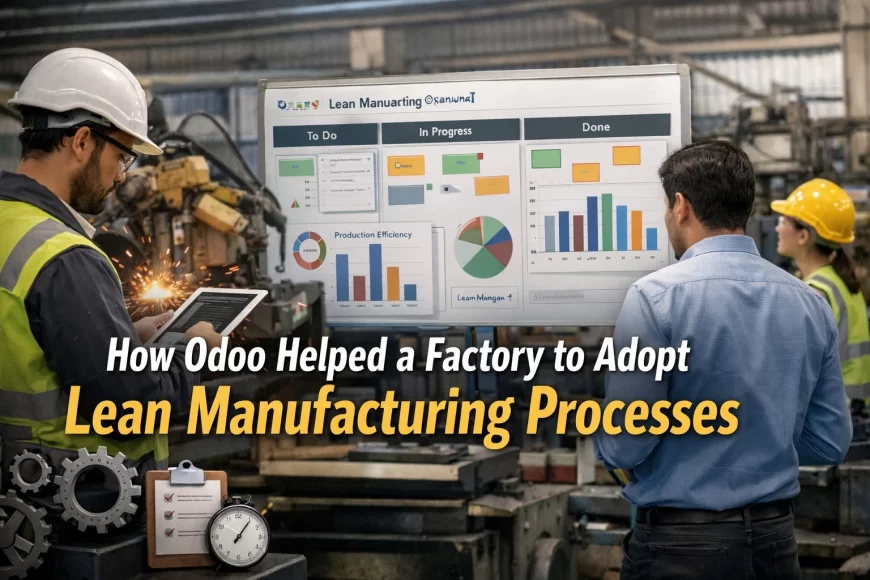
- KPIs—downtime, scrap, throughput, cycle times—updated live.
- Team leads acted quickly because waste was visible immediately.
3. Standard Work Through Digital SOPs
- BOM, routing, quality steps, and approvals standardized execution.
- Consistency reduced rework and improved first-pass yield.
4. Inventory Accuracy for True Lean Pull
- Barcode-driven receipts and issues eliminated stock surprises.
- Material movement became traceable and reliable.
5. Maintenance Discipline → Higher Line Availability
- Preventive maintenance schedules reduced unplanned downtime.
- MTTR and MTBF metrics guided improvement cycles.
Documented Lean Outcomes
Small shifts built into daily habits produced measurable impact within months:
- 30% reduction in WIP stagnation
- 25% faster changeovers (enabled by clear digital routines)
- 40% decrease in repeat defects through early detection
- Higher schedule adherence and smoother production flow
- Increased confidence in costing and variance control
Lean became repeatable, visible, and self-correcting—not dependent on individual memory.
Why Odoo Accelerated Lean Adoption
- Lean thrives on visibility → Odoo made waste measurable.
- Lean requires stable processes → Odoo standardized execution.
- Lean depends on empowered teams → Odoo reduced ambiguity at every handover.
- Lean must be sustained → Odoo created routines that reinforce discipline daily.
This combination shifted the factory from reactive management to precision-driven continuous improvement.
Why Businesses Choose RIBS for Lean ERP Projects
RIBS delivers ERP projects with structured governance, ISO 9001:2015-certified processes, and deep experience in manufacturing operations.
- Industry-aligned mapping → Lean workflows, production constraints, real factory behavior
- Governed rollout → stable adoption under real pressure
- Role-based training → teaching teams how to execute, not just use screens
- KPI-ready reporting → actionable metrics for improvement cycles
More about the company: About RIBS Technologies
CTA Block
If Lean performance matters, control must be designed—not left to chance
- Request a procurement-focused demo: Book a Demo
- We are the certified: Odoo ERP Partner
- To know more: About RIBS
- Customers who got benified by us: Clients
FAQs
Q1: Can Odoo support Lean without overcomplicating processes?
A: Yes. Odoo simplifies Lean by standardizing routines, visualizing waste, and guiding teams through structured workflows.
Q2: Does Odoo help reduce rework and variation?
A: With controlled quality checks, evidence capture, and traceability, defects become visible earlier and root causes easier to resolve.
Q3: How does Odoo improve flow and takt alignment?
A: Real-time work orders, WIP visibility, and capacity insights help maintain smooth flow and reduce bottlenecks.
Q4: Does Odoo support Kaizen and continuous improvement?
A: Yes—KPIs, alerts, and exception data create a feedback loop that enables recurring improvement cycles.
Q5: Is Odoo suitable for both discrete and batch environments?
A: Odoo adapts to discrete, batch, make-to-stock, and make-to-order models without losing operational discipline.