Is Odoo the Right Fit for Your Business Needs?
Discover if Is Odoo Right for My Business is the question your company should ask. Evaluate fit, scalability, control, and growth potential.
 RIbsadmin
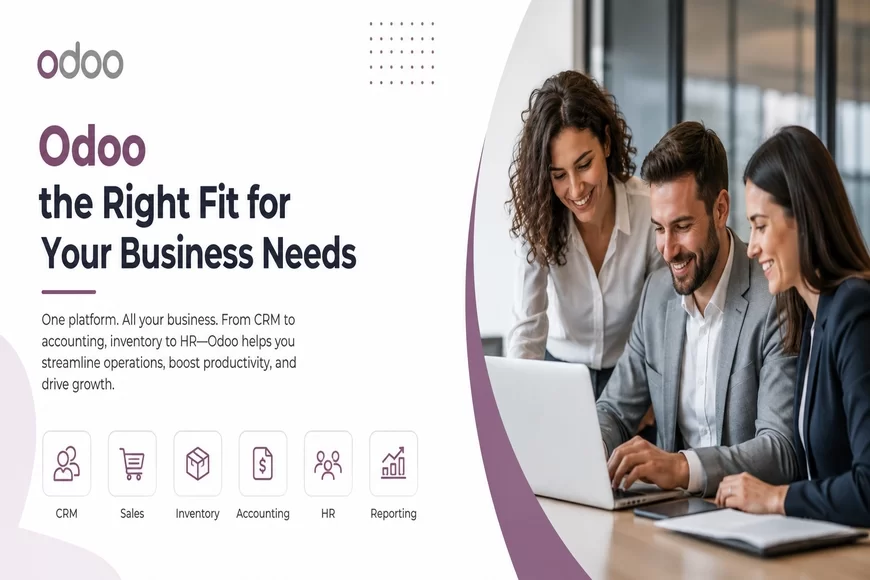
Is Odoo the Right Fit for Your Business Needs?
The real question is not whether Odoo can do more—it's whether it can simplify how your business operates.
Many organizations do not struggle because they lack software. They struggle because critical information lives in different systems, approvals depend on follow-ups, and leaders make decisions with incomplete visibility.
Odoo ERP is often a strong fit when the goal is to create a single operating environment across finance, sales, inventory, procurement, projects, HR, manufacturing, and customer service. The outcome is not just automation—it is greater control, accountability, and decision confidence.
When Odoo Is Usually a Good Fit
Businesses often see value from Odoo when they want to:
- Eliminate disconnected systems and reduce duplicate data entry
- Improve operational speed without losing governance
- Gain real-time visibility across departments
- Scale processes without increasing administrative complexity
- Strengthen accountability through workflows and approvals
- Improve reporting accuracy for better decision-making
If leadership frequently asks, "Which report is correct?" or "Why did we discover this problem too late?", a more connected ERP environment may be worth evaluating.
Who Typically Benefits Most from Odoo?
Growing SMEs
Organizations that have outgrown spreadsheets and disconnected applications often seek better structure without the complexity of large enterprise platforms.
Multi-Department Businesses
Companies that need finance, sales, inventory, procurement, and operations working from the same data source.
Manufacturers and Distributors
Businesses that depend on inventory accuracy, planning discipline, traceability, and operational visibility.
Service Organizations
Companies looking to connect projects, resources, billing, approvals, and customer service in one platform.
Signs Your Current Systems May Be Limiting Growth
- Teams maintain multiple versions of the same data
- Reporting requires manual consolidation
- Approvals depend on emails and follow-ups
- Inventory accuracy is difficult to trust
- Operational issues are identified too late
- Process knowledge depends heavily on specific individuals
These are often symptoms of fragmented systems rather than isolated process problems.
When Odoo May Not Be the Right Choice
Every ERP platform has strengths and limitations.
Odoo may require careful evaluation if:
- Business processes are extremely niche or highly specialized
- Significant industry-specific customization is expected
- Internal teams are not prepared for process standardization
- ERP adoption and change management are not organizational priorities
A structured discovery phase helps determine fit before major investments are made.
How to Evaluate Odoo Correctly
Avoid selecting ERP software based only on feature lists.
Instead, evaluate:
- Current operational bottlenecks
- Reporting requirements
- Growth objectives
- Governance expectations
- Integration requirements
- User adoption readiness
The strongest ERP decisions focus on business outcomes, not software features alone.
Why Businesses Choose RIBS Technologies
Successful ERP projects depend on process alignment, governance, adoption, and continuous improvement.
RIBS Technologies is an ISO 9001:2015-certified software development company helping organizations design ERP environments that support operational control and long-term scalability.
Core Odoo Manufacturing Services
Choose the service layer that strengthens operational control first
- Odoo Consulting: Define workflows, controls, KPIs, and rollout priorities: Odoo Software Consulting Services
- Odoo Implementation: Configure modules, roles, approvals, and reporting structure: Odoo Apps Implementation Services
- Odoo Customization: Extend features without destabilizing the system: Odoo Application Customization Services
- Odoo Integration: Connect data flows across business systems: Odoo Application Integration Services
- Workflow Automation: Reduce delays with controlled automation: Odoo Apps Workflow Automation Services
- Analytics and Reporting: Build KPI reporting that drives action: Odoo Apps Analytics and Reporting Services
- Support and Maintenance: Protect uptime, ad option, and controlled improvements: Odoo Apps Support and Maintenance Services
CTA Block
The fastest way to determine fit is through structured evaluation—not assumptions.
- Book a consultation: Contact RIBS Technologies
- We are the certified: Odoo ERP Partner
- To know more: About RIBS
- Customers who got benefits from us: Clients
FAQs
Q1: Is Odoo suitable for small and mid-sized businesses?
A: Yes. Many SMEs adopt Odoo because it offers a modular approach that can expand as operational requirements grow.
Q2: Can Odoo support multiple departments in one system?
A: Yes. Odoo is designed to connect business functions such as finance, sales, inventory, HR, projects, and operations.
Q3: How do I know if Odoo fits my business?
A: A discovery and fit-gap assessment helps evaluate business processes, reporting needs, and operational objectives before implementation.
Q4: Is Odoo only for manufacturing companies?
A: No. Odoo supports manufacturing, trading, distribution, service, retail, and many other business models.
Q5: What is the biggest advantage of Odoo?
A: For many organizations, the primary benefit is creating a single source of operational and financial truth across departments.