How Odoo Helps Businesses Stay Competitive
Discover how How Odoo Helps Businesses Stay Competitive by improving efficiency, automation, visibility, and decision-making for growing UAE businesses.
 RIbsadmin
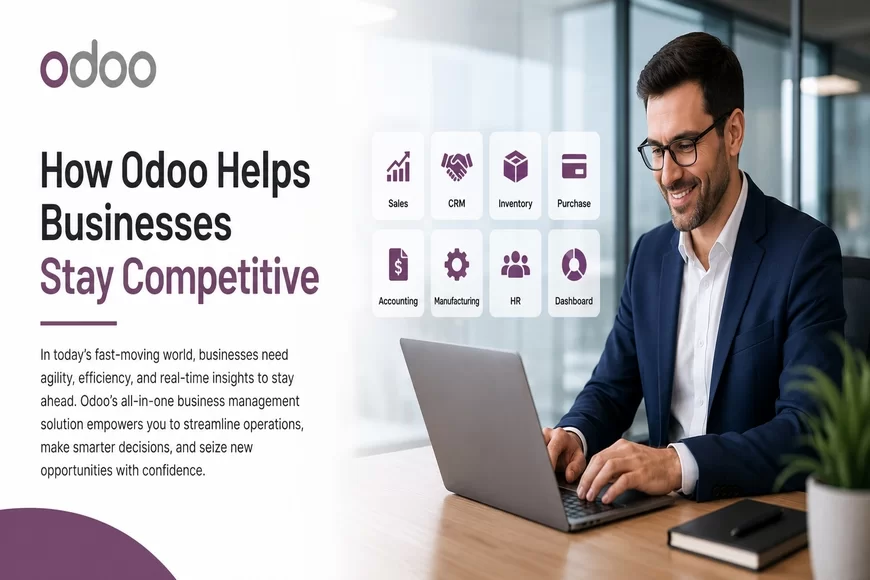
How Odoo Helps Businesses Stay Competitive
Stay Competitive with Odoo ERP
Build a business that responds faster, operates smarter, and grows with confidence
Markets change quickly. Customer expectations rise, costs fluctuate, and competitors adapt faster than ever. Businesses that rely on disconnected systems often struggle with slow decisions, inconsistent data, and manual processes. Odoo ERP brings business functions together into one connected platform, helping organizations improve visibility, strengthen operational control, and make better decisions with greater confidence.
Whether you operate in Dubai, Abu Dhabi, or Sharjah, staying competitive begins with replacing uncertainty with structured execution.
Why Competitive Businesses Choose Odoo
Long-term growth depends on consistent execution, not occasional success. Odoo helps businesses standardize workflows, improve collaboration, and reduce delays that affect customer experience and profitability.
Business advantages include:
- Better decision-making: Access real-time information instead of waiting for manual reports.
- Faster operations: Reduce repetitive tasks through automated workflows.
- Stronger collaboration: Keep every department working from the same data.
- Greater visibility: Monitor KPIs, approvals, and business performance from one platform.
- Scalable growth: Expand operations without increasing process complexity.
How Odoo Creates Competitive Advantage
Competition is rarely won by working harder. It is won by making better decisions sooner and executing them consistently.
Odoo helps businesses by:
- Improving operational efficiency across departments.
- Reducing manual errors and duplicate data entry.
- Accelerating approval cycles and business processes.
- Increasing reporting accuracy with centralized information.
- Supporting controlled business expansion through standardized workflows.
Business Areas Connected Through Odoo
A connected business responds faster because every department works from the same operational reality.
- Finance: Better financial visibility and reporting.
- Inventory & Supply Chain: Improved stock control and procurement planning.
- Sales & CRM: Stronger customer relationship management and sales visibility.
- Human Resources: Centralized employee and attendance management.
- Analytics: Live dashboards for faster management decisions.
Competitive Outcomes
Organizations implementing structured ERP processes often work toward outcomes such as:
- Reduced manual administration
- Faster internal approvals
- Better customer response times
- Improved operational transparency
- Higher confidence in management reporting
A Practical Implementation Approach
Successful ERP adoption is achieved through structured planning rather than rapid deployment.
Typical project stages:
- Business discovery and process review
- Solution design and configuration
- Data migration and validation
- User training and testing
- Go-live support and continuous improvement
Why RIBS Technologies
Technology creates value only when people continue using it confidently after implementation.
RIBS Technologies delivers structured ERP implementations with a focus on governance, adoption, process consistency, and long-term operational stability.
Core Odoo Service Lines
Choose the service layer that removes the most risk first
- Odoo Consulting: Define workflows, controls, KPIs, and rollout priorities: Odoo Software Consulting Services
- Odoo Implementation: Configure modules, roles, approvals, and reporting structure: Odoo Apps Implementation Services
- Odoo Customization: Extend features without destabilizing the system: Odoo Application Customization Services
- Odoo Integration: Connect data flows across business systems: Odoo Application Integration Services
- Workflow Automation: Reduce delays with controlled automation: Odoo Apps Workflow Automation Services
- Analytics and Reporting: Build KPI reporting that drives action: Odoo Apps Analytics and Reporting Services
- Support and Maintenance: Protect uptime, ad option, and controlled improvements: Odoo Apps Support and Maintenance Services
Ready to Build a More Competitive Business?
Every delay, duplicate process, and disconnected report creates hidden operational costs. A connected ERP platform helps organizations respond faster, improve customer experience, and create a stronger foundation for sustainable growth.
- Book a demo: Request Demo
- We are the certified: Odoo ERP Partner
- To know more: About RIBS
- Customers who got benified by us: Clients
FAQs
Q1. How does Odoo improve business competitiveness?
Odoo connects business processes into one platform, improving visibility, reducing manual work, and supporting faster decision-making.
Q2. Is Odoo suitable for growing businesses?
Yes. Odoo supports organizations that want standardized processes while expanding operations.
Q3. Can Odoo integrate multiple departments?
Yes. Finance, sales, inventory, HR, procurement, and other business functions can operate from one integrated system.
Q4. How long does implementation usually take?
The timeline depends on business size, selected modules, integrations, and project complexity.
Q5. Why choose an experienced implementation partner?
A structured implementation improves user adoption, minimizes project risk, and supports long-term system stability.