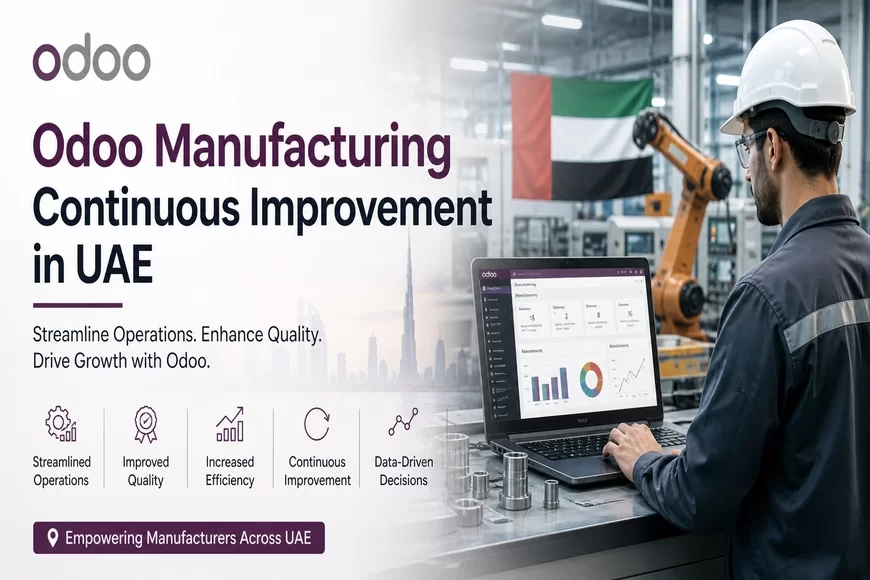
Odoo Manufacturing Continuous Improvement in UAE
Drive measurable gains with Odoo Manufacturing Continuous Improvement. Reduce rework, downtime, and cost variance across UAE factories
 RIbsadmin
Odoo Manufacturing Continuous Improvement
Turn daily operations into measurable progress—not repeated firefighting
Most factories do not fail from lack of effort—they stall because the same issues return in different forms. Delays, rework, downtime, and cost variance often become “accepted patterns.” Continuous improvement in Odoo Manufacturing ERP changes that pattern by converting every exception into a measurable signal—so improvement becomes structured, not dependent on memory or meetings.
For manufacturers in Dubai, Abu Dhabi, and Sharjah, the objective is clear: stabilize performance first, then scale with confidence.
What Continuous Improvement Means in Odoo
From reactive fixes to controlled optimization cycles
Odoo enables a closed-loop system where production, quality, maintenance, and costing data continuously feed improvement decisions. Instead of asking “what went wrong,” teams can act on what is consistently measurable.
What leadership gains
- Visibility into patterns: recurring issues become visible across shifts, lines, and sites
- Controlled improvements: changes are tracked, validated, and standardized
- KPI-driven decisions: scrap, downtime, adherence, and variance guide action
- Repeatable progress: improvements are embedded into workflows—not lost over time
High-Intent CTA (UAE)
Move from “fixing issues” to “eliminating recurrence”
- Request a performance review: identify repeat loss areas: Book a Demo
- Plan an optimization roadmap: align KPIs with improvement cycles: Contact Us
Why Continuous Improvement Matters in Manufacturing ERP
Because small inefficiencies compound into large losses
Without a structured improvement loop, factories often repeat the same mistakes—under different conditions. Odoo helps convert operational data into clear improvement priorities, so effort is focused where it creates measurable impact.
Target outcomes
- Reduced rework cycles: quality issues are identified earlier and corrected faster
- Lower downtime impact: maintenance signals improve asset reliability
- Stronger schedule adherence: planning deviations are tracked and corrected
- Improved cost control: variance visibility supports better financial discipline
Core Improvement Capabilities in Odoo
Connect data, decisions, and execution
- KPI dashboards: track throughput, scrap, downtime, and adherence
- Quality signals: NCR, CAPA, and alerts highlight root causes
- Maintenance insights: MTBF and MTTR trends guide reliability improvements
- Inventory accuracy signals: stock variances expose process gaps
- Workflow feedback loops: approvals and exceptions feed improvement actions
Supporting execution layers: Odoo Manufacturing ERP and Odoo Productivity Management Software
Continuous Improvement Cycle (Practical Model)
A structured loop that builds confidence over time
- Measure: capture real-time production, quality, and cost signals
- Analyze: identify repeat deviations and constraint points
- Improve: implement controlled process or system changes
- Validate: confirm impact through measurable KPIs
- Standardize: embed successful changes into workflows
How RIBS Drives Continuous Improvement
Because improvement without structure creates noise—not results
RIBS aligns improvement initiatives with governance, KPIs, and operational reality, ensuring changes are adopted and sustained.
- KPI definition: align metrics with plant-level priorities
- Dashboard design: focus on actionable, decision-ready data
- Controlled changes: validate improvements before scaling
- Role-based ownership: assign accountability for each KPI
- Phased optimization: improve in cycles—not in disruption-heavy waves
Implementation support: Odoo Apps Implementation Services
Where Continuous Improvement Delivers Fastest Value
Focus on areas where loss is frequent and measurable
- Production bottlenecks and routing inefficiencies
- Recurring quality defects and rework loops
- Maintenance-driven downtime patterns
- Inventory inconsistencies affecting planning
- Approval delays slowing execution
Stability Before Optimization
Because unstable systems cannot improve consistently
Continuous improvement works only when the system is stable. RIBS ensures baseline processes, data accuracy, and user adoption are controlled before scaling optimization efforts.
Support structure: Odoo Apps Support and Maintenance Services
Why RIBS Technologies
Because sustainable improvement requires discipline, not urgency
RIBS Technologies is an ISO 9001:2015-certified software development company delivering ERP programs designed for measurable improvement and controlled scaling.
- Finance & accounting: invoicing discipline and reporting confidence with Odoo Finance Process Applications
- Sales operations: pipeline clarity and order consistency with Odoo Sales Applications
- Supply chain: procurement and inventory accuracy with Odoo Supply Chain Applications
- HR & governance: standardised workflows and approvals with Odoo Human Resources Applications
- Services & delivery: accountability for projects and services using Odoo Services Applications
- Productivity & approvals: enforce ownership with Odoo Productivity Applications
Explore more: About RIBS Technologies
CTA Block - Odoo Manufacturing Continuous Improvement
If performance matters, improvement must be continuous—not occasional
- Book a demo: Request Demo
- We are the certified: Odoo ERP Partner
- To know more: About RIBS
- Customers who got benified by us: Clients
FAQs - Odoo Manufacturing Continuous Improvement
Q1: What is continuous improvement in Odoo Manufacturing ERP?
A: It is a structured approach where operational data—production, quality, maintenance, and costing—is used to identify, validate, and standardize improvements continuously.
Q2: How does Odoo support continuous improvement cycles?
A: Odoo provides KPI dashboards, quality alerts, maintenance insights, and workflow tracking—helping teams measure, analyze, improve, and standardize changes.
Q3: When should continuous improvement start after implementation?
A: After system stabilization—once data accuracy, workflows, and user adoption are consistent enough to produce reliable performance signals.
Q4: What KPIs are typically tracked in manufacturing improvement?
A: Common KPIs include scrap rate, downtime, schedule adherence, throughput, and cost variance.
Q5: Why is a structured approach important for improvement?
A: Without structure, improvements remain temporary. A governed approach ensures changes are measurable, validated, and sustained.