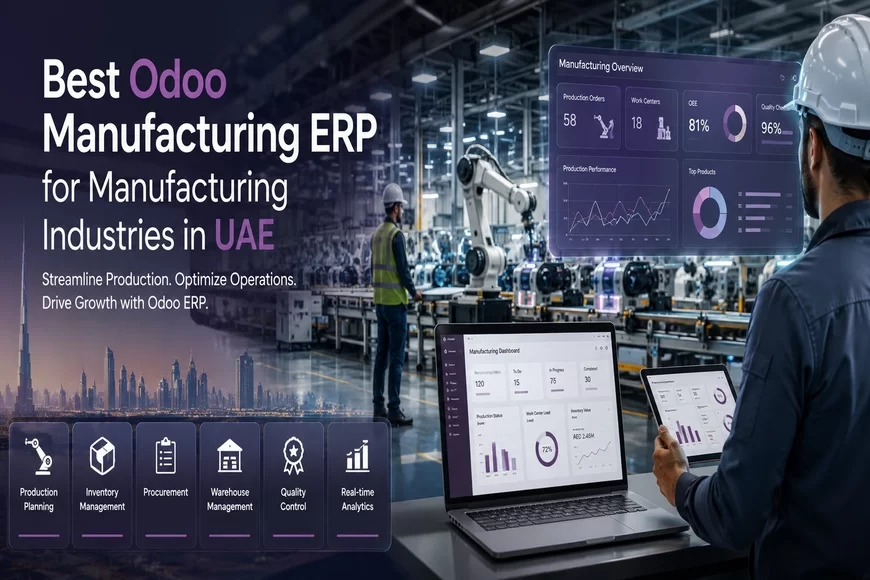
Best Odoo Manufacturing ERP for Manufacturing Industries in UAE
Evaluate the Best ERP for Manufacturing UAE. Improve production, inventory, quality, maintenance, and costing visibility with Odoo ERP.
 RIbsadmin
Best ERP for Manufacturing in UAE
Choose an ERP that creates control, not complexity
The best ERP for a manufacturing company is not the one with the longest feature list. It is the system that helps teams make better decisions, execute consistently, and maintain control as operations grow.
For manufacturers in Dubai, Abu Dhabi, and Sharjah, operational pressure often comes from the same areas—production delays, inventory inaccuracies, quality issues, downtime, disconnected reporting, and limited costing visibility. A modern manufacturing ERP should help reduce these risks while creating a single source of operational truth.
Odoo Manufacturing ERP brings production, inventory, quality, maintenance, procurement, and finance into one connected platform—helping manufacturers improve visibility, accountability, and execution discipline.
What Makes an ERP Suitable for UAE Manufacturers?
Selecting an ERP is a long-term operational decision. The right platform should support both today's requirements and future growth without creating unnecessary complexity.
Key evaluation criteria
- Real-time visibility: access operational data without waiting for manual reports.
- Inventory control: improve stock accuracy and traceability.
- Production management: structured planning, routing, and work order execution.
- Quality governance: inspections, quality alerts, and traceable records.
- Maintenance discipline: preventive maintenance and downtime visibility.
- Costing confidence: understand production costs and variances earlier.
- Role-based control: approvals and access aligned to responsibilities.
Why Many UAE Manufacturers Consider Odoo
Control the processes that directly influence profitability
Odoo combines manufacturing operations with supporting business functions in one environment.
Core manufacturing capabilities
- Odoo MRP for production planning and material requirements.
- Odoo quality management for inspections and quality controls.
- Odoo inventory barcode processes for stock accuracy.
- Odoo maintenance module for preventive maintenance planning.
- Odoo BOM and PLM for engineering and change management.
Questions Manufacturers Should Ask Before Choosing an ERP
The safest ERP decisions are usually driven by operational requirements rather than software demonstrations.
Consider evaluating:
- Can the ERP support your production model?
- Can it provide reliable inventory visibility?
- Can it support quality and traceability requirements?
- Can it scale across multiple plants or entities?
- Can teams adopt it without excessive complexity?
- Can reporting support management decision-making?
Common Manufacturing Scenarios
Discrete Manufacturing
- BOM control
- Routing management
- Work order execution
- Serial number traceability
Batch & Process Manufacturing
- Lot tracking
- Quality checkpoints
- Yield monitoring
- Production traceability
Multi-Site Operations
- Standardized reporting
- Centralized visibility
- Controlled approvals
- Consistent operational governance
Implementation Matters as Much as Software
ERP success is influenced by process design, data quality, user adoption, and governance.
A structured implementation typically includes:
- Discovery and fit-gap assessment
- Process design and configuration
- Data migration and validation
- User acceptance testing
- Training and adoption support
- Go-live stabilization
The objective is not simply to deploy software—but to create a system people trust and use consistently.
Why RIBS Technologies
Manufacturers often seek implementation partners who understand operational realities, not just software configuration.
RIBS Technologies helps organizations align ERP systems with production workflows, reporting requirements, and governance objectives.
Core Odoo Manufacturing Services
Choose the service layer that strengthens operational control first
- Odoo Consulting: Define workflows, controls, KPIs, and rollout priorities: Odoo Software Consulting Services
- Odoo Implementation: Configure modules, roles, approvals, and reporting structure: Odoo Apps Implementation Services
- Odoo Customization: Extend features without destabilising the system: Odoo Application Customization Services
- Odoo Integration: Connect data flows across business systems: Odoo Application Integration Services
- Workflow Automation: Reduce delays with controlled automation: Odoo Apps Workflow Automation Services
- Analytics and Reporting: Build KPI reporting that drives action: Odoo Apps Analytics and Reporting Services
- Support and Maintenance: Protect uptime, ad option, and controlled improvements: Odoo Apps Support and Maintenance Services
CTA Block - Best ERP for Manufacturing in UAE
The best ERP decision reduces uncertainty before it reduces cost
- Book a demo: Contact RIBS Technologies
- We are the certified: Odoo ERP Partner
- To know more: About RIBS
- Customers who got benefits from us: Clients
FAQs - Best ERP for Manufacturing in UAE
Q1: What is the best ERP for manufacturing companies in UAE?
A: The best ERP depends on production complexity, reporting requirements, operational controls, and future growth objectives. Manufacturers typically evaluate visibility, traceability, scalability, and adoption requirements before selecting a platform.
Q2: Is Odoo suitable for manufacturing businesses?
A: Odoo includes manufacturing, inventory, quality, maintenance, procurement, and finance applications that can support a wide range of manufacturing operations.
Q3: Can Odoo support multi-site manufacturing operations?
A: Yes. Odoo provides capabilities that can help manage multiple locations, entities, and operational reporting structures depending on implementation design.
Q4: How long does manufacturing ERP implementation take?
A: Timelines vary based on scope, users, data quality, integrations, and process complexity. Discovery and planning usually determine a realistic timeline.
Q5: What affects manufacturing ERP project costs?
A: Cost is influenced by users, modules, integrations, customization requirements, data migration effort, reporting needs, training, and support expectations.