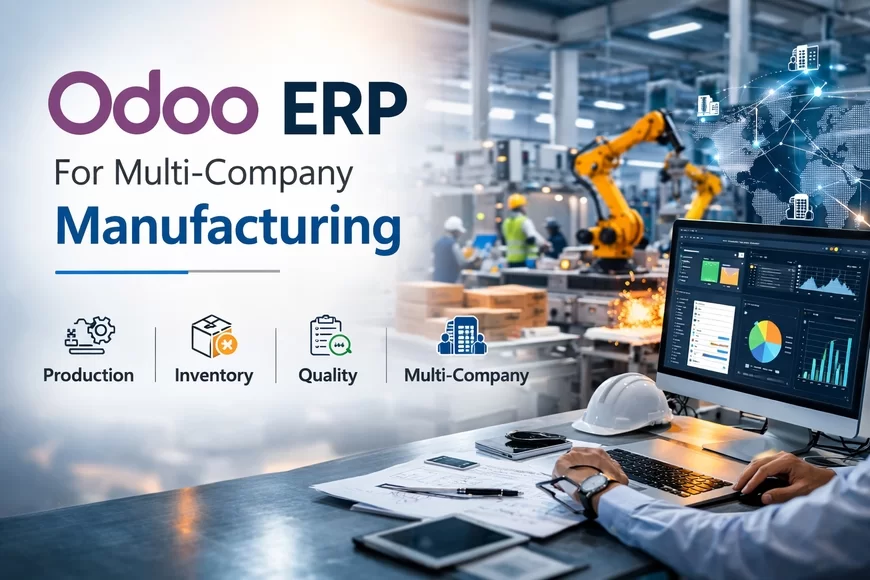
Odoo ERP For Multi-Company Manufacturing
Manage multiple factories and entities with Odoo Multi-Company Manufacturing ERP. Gain unified visibility, controlled intercompany workflows, and scalable operations.
 RIbsadmin
Odoo Multi-Company Manufacturing ERP
Control multiple factories, companies, and operations—without losing visibility
Manufacturing groups rarely operate as a single entity. Expansion creates multiple companies, plants, warehouses, and business units. Over time, each entity develops its own spreadsheets, approvals, and reporting habits.
The result is subtle but costly: fragmented data, slow decisions, and inconsistent control.
Odoo Multi-Company Manufacturing solves this challenge by creating a structured environment where several companies can operate independently while leadership maintains clear operational oversight.
Instead of juggling disconnected systems, manufacturers gain a unified operational framework that supports both autonomy and governance.
The psychological shift is powerful:
teams stay focused on production while leadership sees the entire picture.
Why Multi-Company Manufacturing Becomes Difficult
Growth brings complexity. New subsidiaries, regional plants, or acquired businesses introduce different processes and reporting structures. Without a structured ERP model, operations drift apart.
Common operational signals include:
- Each company running separate spreadsheets for production tracking
- Inventory transfers between companies becoming manual or unclear
- Management struggling to compare production performance across plants
- Cost visibility weakening across multiple entities
- Compliance and reporting becoming harder to control
These problems rarely appear overnight. They grow quietly as operations scale.
A multi-company ERP architecture restores discipline before fragmentation becomes permanent.
How Odoo Supports Multi-Company Manufacturing
Odoo allows multiple legal entities to operate inside a single ERP environment while maintaining secure data separation.
Each company can manage its own:
- Production orders
- Warehouses and inventory
- Bills of materials and routings
- Accounting and financial records
- Sales and procurement operations
At the same time, leadership gains a central command view across companies.
This balance is critical:
local teams operate efficiently while executives maintain strategic visibility.
Operational Advantages for Manufacturing Groups
Multi-company structure in Odoo creates measurable operational clarity.
1. Cross-Company Production Visibility
Executives can review production performance across plants without waiting for separate reports. Real-time dashboards reveal capacity utilization, delays, and throughput.
2. Controlled Inter-Company Transactions
Material transfers between companies—such as raw materials supplied by one entity and consumed by another—can follow structured inter-company workflows.
This reduces accounting confusion and inventory mismatches.
3. Shared Master Data with Governance
Companies can share controlled master data such as products, components, or vendors while still maintaining company-specific rules when required.
This improves consistency across operations.
4. Financial Separation with Group Insight
Each company maintains its own financial books while management can analyze group-level performance.
This is especially valuable for manufacturing groups managing multiple legal entities or joint ventures.
5. Scalable Expansion
New subsidiaries or plants can be added without rebuilding the system architecture. The ERP grows with the organization.
When Multi-Company ERP Becomes Necessary
Not every manufacturer needs this structure immediately. However, it becomes essential when organizations experience:
- Multiple legal entities under one ownership group
- Production plants in different locations
- Separate accounting or regulatory requirements
- Shared inventory or procurement between companies
- Group-level management reporting
At this stage, operating on disconnected systems becomes a strategic risk.
Governance and Data Control
Multi-company ERP introduces new governance requirements. Access control, role permissions, and reporting structures must be carefully designed.
Odoo supports:
- Company-level access rights
- Role-based permissions for managers and operators
- Secure data separation between entities
- Consolidated operational reporting
This ensures information remains accessible where needed but protected where required.
Operational discipline increases because the system removes ambiguity from cross-company processes.
Typical Multi-Company Manufacturing Scenarios
Manufacturers often implement this structure for situations such as:
- A holding company managing several production subsidiaries
- Regional manufacturing units serving different markets
- A trading company supplying raw materials to manufacturing entities
- Contract manufacturing units operating under separate legal entities
- A group managing both manufacturing and distribution companies
In each case, Odoo allows the group to function as one coordinated system rather than isolated businesses.
Implementation Considerations
Multi-company ERP requires thoughtful design before deployment. Key planning areas include:
- Company hierarchy and structure
- Shared versus separate product data
- Inter-company inventory movement rules
- Accounting relationships between entities
- Reporting requirements for management
A discovery phase ensures the system architecture reflects the real operating model rather than forcing teams to change workflows unnecessarily.
Careful planning reduces operational disruption and builds long-term system stability.
The Strategic Value
When manufacturing groups gain a unified view across companies, decisions become faster and more confident.
Leadership can:
- identify production bottlenecks earlier
- allocate resources between plants
- standardize best practices across entities
- evaluate expansion opportunities with clearer data
In practice, the most valuable outcome is not just better reporting.
It is organizational alignment.
When systems reflect how the group actually operates, teams stop improvising and start executing with consistency.
CTA- Odoo Multi-Company Manufacturing ERP
If your manufacturing group operates across multiple companies, clarity becomes a strategic advantage.
You can:
- Book a demo: Contact
- evaluate whether your structure requires multi-company ERP
- review current operational fragmentation risks
- design a scalable architecture for future growth
FAQs- Odoo Multi-Company Manufacturing ERP
Q1: What is multi-company manufacturing in Odoo?
It allows several companies to operate in one ERP system while keeping operational and financial data separated.
Q2: Can companies share inventory in Odoo?
Yes. Structured inter-company transactions support controlled inventory movement.
Q3: Is financial reporting separated by company?
Yes. Each company maintains its own accounting records.
Q4: Can management view consolidated operations?
Yes. Leadership can analyze performance across companies.
Q5: Is multi-company suitable for growing manufacturing groups?
Yes. It helps maintain operational discipline as organizations expand.