Odoo vs Traditional ERP Systems: A Complete Comparison
Compare Odoo vs Traditional ERP Systems to choose the right ERP for cost, control, scalability, and modernization. See why UAE businesses prefer Odoo
 RIbsadmin
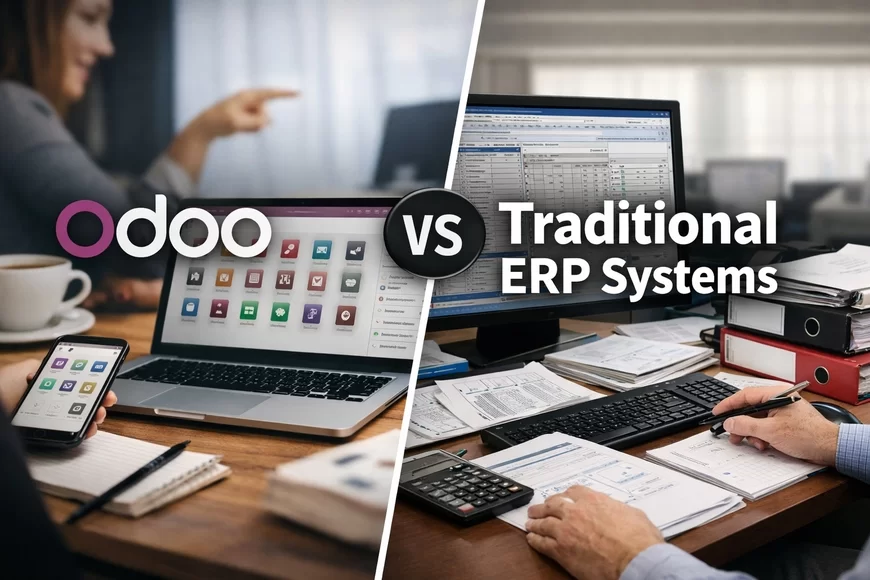
Odoo vs. Traditional ERP Systems: A Complete Comparison
Choose Control Without Complexity
When businesses outgrow spreadsheets and fragmented tools, the next decision becomes critical: adopt a modern, scalable system like Odoo, or commit to a traditional ERP that often brings heavy cost, slow implementation, and limited flexibility.
This comparison helps leaders choose with clarity, confidence, and long-term value in mind.
Why This Comparison Matters
ERP decisions shape your next decade of growth.
Traditional ERPs offer structure—but often at the cost of agility, user adoption, and high ownership fees. Odoo delivers a flexible, modular, and scalable ERP ecosystem that evolves with your business—without forcing unnecessary complexities.
Odoo vs. Traditional ERPs — Core Difference
|
Area |
Odoo |
Traditional ERPs |
|
Cost |
Lower TCO, modular |
High licensing + recurring fees |
|
Flexibility |
Easily customizable |
Rigid, expensive to modify |
|
Implementation Speed |
Fast & phased |
Long, multi-year projects |
|
User Adoption |
Modern, intuitive |
Complex, training-heavy |
|
Scalability |
Add modules instantly |
Expensive expansions |
|
Integration |
Built-in & API-ready |
Limited / costly |
|
Industry Fit |
Any SMB–mid enterprise |
Mostly mid-large enterprise |
|
Updates |
Continuous |
Rare, major upgrades only |
Ideal for UAE Businesses
Odoo is preferred by high-growth UAE companies because it reduces operational friction, improves reporting clarity, and keeps ownership costs in control—without sacrificing capability or governance.
Why Businesses Switch to Odoo
Because modern companies need speed, clarity, and adaptability—not red tape.
- Lower operational cost: pay only for modules you use
- Better execution control: workflows, approvals, KPIs
- Faster decision cycles: real-time consolidated data
- Reduced dependency on IT: business teams take ownership
- Phased scalability: expand apps as business grows
Odoo maximizes operational readiness while minimizing complexity—helping leaders think strategically and act decisively.
Key Advantages of Odoo Over Traditional ERP Systems
1. Cost Efficiency
Traditional ERPs demand heavy licensing, user fees, maintenance contracts, and costly upgrades.
Odoo delivers enterprise capability without the enterprise burden—cutting TCO by 40–70%.
2. Faster Implementation
Traditional ERPs often take 12–36 months.
Odoo is delivered in controlled phases, reducing risk and accelerating value realization.
3. Customization Without Complexity
Odoo’s modular framework allows precise fitment without breaking the core—something traditional ERPs struggle to offer without expensive development.
4. User-Friendly Experience
A system only works when people use it.
Odoo’s intuitive interface improves adoption, reduces training time, and increases productivity.
5. Continuous Innovation
Traditional ERP upgrades are disruptive and expensive.
Odoo updates yearly with enhanced UX, automation, integrations, and security—keeping your business future-ready.
When Traditional ERP Still Wins
Odoo is not the right choice for every scenario.
Traditional ERP systems may benefit organizations that require:
- Extremely complex, highly regulated, global operations
- Thousands of users across multiple regions
- Deep, industry-specific proprietary modules
For all others—especially SMBs and mid-sized enterprises—Odoo provides better value, speed, and control.
Explore the platform foundation: Odoo ERP Solutions and Odoo All Apps ERP Software Solution
CTA (Decision-Ready)
If you're choosing an ERP, choose one that evolves with you—not one that restricts you.
- Request a procurement-focused demo: Book a Demo
- We are the certified: Odoo ERP Partner
- To know more: About RIBS
- Customers who got benified by us: Clients
FAQs (Schema-Ready)
Q1: Is Odoo suitable for companies using legacy ERPs?
A: Yes. Many businesses migrate from SAP, Oracle, and custom ERPs to reduce cost, simplify operations, and improve usability.
Q2: Does Odoo support UAE compliance and VAT?
A: Yes. Odoo includes VAT-ready accounting, approval governance, and audit-friendly reporting.
Q3: Can Odoo integrate with existing systems?
A: Yes. Odoo supports API integrations, allowing phased transition without disrupting operations.
Q4: How does Odoo reduce ERP ownership cost?
A: Lower licensing fees, modular pricing, fewer maintenance expenses, and faster implementations reduce TCO significantly.
Q5: Is Odoo secure enough for enterprise use?
A: Yes. Odoo uses modern security protocols, access control, audits, and continuous updates.