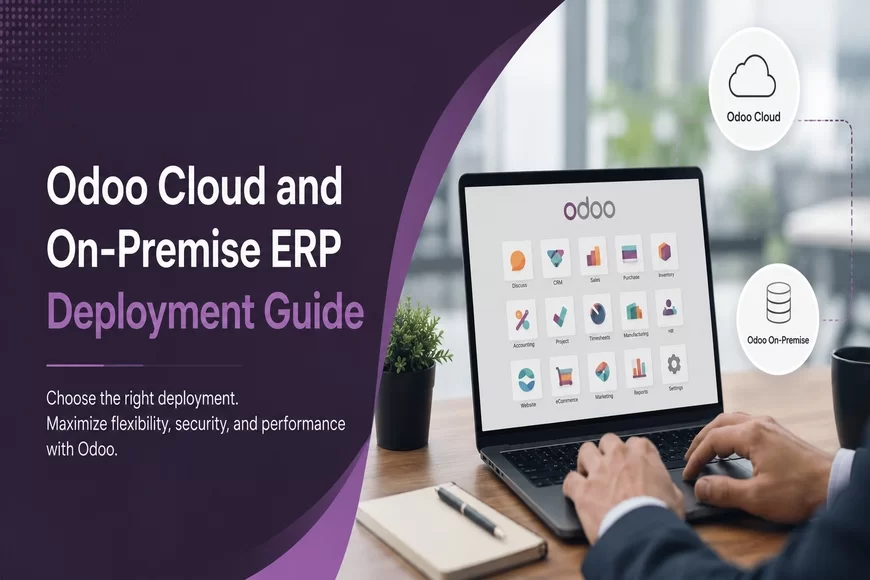
Odoo Cloud and On-Premise ERP Deployment Guide
Compare Odoo Cloud and On-Premise deployment options. Understand accessibility, control, scalability, and governance before implementation.
 RIbsadmin
Is Odoo Available as Cloud-Based or On-Premise Software?
Deployment Flexibility Without Compromising Control
One of the reasons businesses choose Odoo ERP is deployment flexibility. Every organization has different priorities—some focus on accessibility and scalability, while others prioritize infrastructure control and internal governance.
Odoo is available as both cloud-based and on-premise software.
This allows businesses to select the deployment model that aligns with their operational requirements, IT strategy, security preferences, and growth plans.
Cloud-Based Odoo
Access your business from anywhere with centralized visibility
Cloud deployment is often selected by organizations that want faster deployment, simplified infrastructure management, and remote accessibility.
Benefits of Cloud Odoo
- Access from anywhere: Teams can securely access the system through the internet.
- Faster deployment: Reduced infrastructure preparation and setup effort.
- Easy scalability: Add users and business functions as operations expand.
- Centralized updates: Simplified management of system enhancements and maintenance.
- Lower infrastructure burden: Reduced dependency on internal server management.
For businesses focused on agility and growth, cloud deployment can help accelerate adoption while maintaining operational visibility.
On-Premise Odoo
Greater infrastructure control for organizations with specific governance requirements
Some businesses prefer maintaining ERP infrastructure within their own environment for operational, regulatory, or internal policy reasons.
Benefits of On-Premise Odoo
- Infrastructure control: Systems are hosted within your organization’s environment.
- Internal governance alignment: Supports company-specific IT policies and controls.
- Custom infrastructure management: Greater flexibility over hosting architecture.
- Controlled system administration: Internal teams maintain oversight of system resources.
This model is commonly evaluated by organizations with established IT environments and specific operational governance requirements.
How to Choose the Right Deployment Model
The best option depends on business priorities rather than technology trends.
Consider:
- Number of users and locations
- Internal IT capabilities
- Security and governance policies
- Growth expectations
- Integration requirements
- Long-term maintenance strategy
The objective is not simply selecting cloud or on-premise—it is selecting the model that supports business continuity, adoption, and scalability.
Need Help Evaluating the Right Odoo Deployment?
A structured assessment helps organizations avoid costly changes later by aligning deployment decisions with operational realities from the start.
- Book a consultation to evaluate deployment options.
- Request a tailored demo aligned to your business processes.
- Discuss scalability requirements before implementation planning begins.
Why RIBS Technologies
Successful ERP deployment requires more than infrastructure decisions. It requires governance, adoption planning, process alignment, and long-term scalability.
RIBS Technologies helps businesses evaluate deployment approaches based on operational requirements, business objectives, and future growth plans.
Core Odoo Manufacturing Services
Choose the service layer that strengthens operational control first
- Odoo Consulting: Define workflows, controls, KPIs, and rollout priorities: Odoo Software Consulting Services
- Odoo Implementation: Configure modules, roles, approvals, and reporting structure: Odoo Apps Implementation Services
- Odoo Customization: Extend features without destabilizing the system: Odoo Application Customization Services
- Odoo Integration: Connect data flows across business systems: Odoo Application Integration Services
- Workflow Automation: Reduce delays with controlled automation: Odoo Apps Workflow Automation Services
- Analytics and Reporting: Build KPI reporting that drives action: Odoo Apps Analytics and Reporting Services
- Support and Maintenance: Protect uptime, ad option, and controlled improvements: Odoo Apps Support and Maintenance Services
CTA Block
The strongest ERP decision is built on evidence, not assumptions
- Book a consultation: Contact RIBS Technologies
- We are the certified: Odoo ERP Partner
- To know more: About RIBS
- Customers who got benefits from us: Clients
FAQs
Q1: Can Odoo be deployed in the cloud?
A: Yes. Odoo supports cloud deployment, allowing users to access the system through the internet from multiple locations.
Q2: Can Odoo be installed on a company's own servers?
A: Yes. Odoo also supports on-premise deployment for organizations that prefer managing infrastructure internally.
Q3: Which deployment option is better for growing businesses?
A: The answer depends on business goals, IT capabilities, governance requirements, and scalability expectations.
Q4: Can cloud and on-premise deployments support the same business processes?
A: In many cases, both deployment models can support similar ERP processes, subject to implementation and configuration requirements.
Q5: Should deployment strategy be decided before implementation?
A: Yes. Early deployment planning helps align infrastructure, security, budget, and operational objectives.