What Odoo Software Does to Your Business ?
Discover how Odoo software for business connects sales, finance, inventory, and operations into one ERP system that improves visibility, efficiency, and control.
 RIbsadmin

What Odoo Software Does to Your Business
Running a business today often feels like managing multiple disconnected systems—sales tools, accounting software, spreadsheets, inventory platforms, and customer databases. Each system holds pieces of information, but rarely the full picture.
This is where Odoo software changes the way businesses operate.
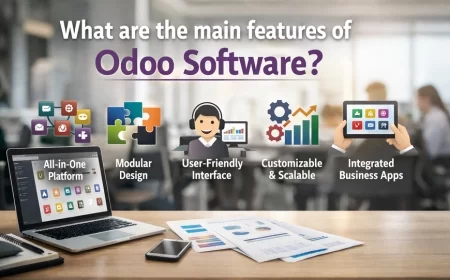
Instead of separate tools working independently, Odoo connects core business functions into a single operational system. Sales, finance, inventory, manufacturing, customer service, and management reporting work together in one environment. The result is not just software efficiency—it is operational clarity.
Businesses that adopt integrated ERP systems often discover a psychological shift inside the organization:
decisions become faster because leaders trust the information they see.
A Single Platform for Business Operations
Many companies grow using separate tools for different departments. While this works initially, complexity increases as the organization expands.
Odoo addresses this challenge by bringing critical business activities into one connected platform:
• Sales and CRM
• Accounting and finance
• Inventory and warehouse management
• Purchasing and supplier management
• Manufacturing and production control
• Human resources and payroll
• Project management and service delivery
When these functions operate together, information flows automatically between teams. A sales order can trigger inventory updates, purchase planning, accounting entries, and delivery preparation without manual coordination.
This integrated approach reduces operational friction and allows businesses to operate with greater consistency and visibility.
Real-Time Visibility for Decision Makers
One of the most valuable outcomes of ERP adoption is real-time operational visibility.
Business leaders often struggle with delayed reporting. Financial reports arrive late. Inventory data may be outdated. Production performance becomes clear only after problems occur.
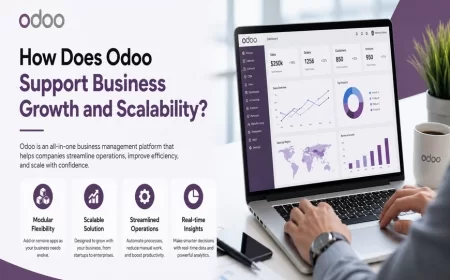
Odoo centralizes operational data so leadership teams can monitor business performance through dashboards and reports that update automatically.
This enables decision makers to quickly understand:
• sales performance trends
• inventory levels and stock movements
• production progress and operational bottlenecks
• financial health and profitability
• project timelines and resource allocation
When leaders see accurate information instantly, they can act earlier and with greater confidence.
Process Automation That Reduces Operational Stress
Manual processes consume time and introduce errors. Teams repeatedly enter the same information across systems, increasing operational risk.
Odoo automates many routine workflows, such as:
• quotation and sales order processing
• purchase order generation
• inventory movements and replenishment
• invoice creation and payment tracking
• approval workflows and internal notifications
Automation does not replace human expertise. Instead, it removes repetitive tasks so employees can focus on decision-making, problem solving, and customer engagement.
Organizations often experience an unexpected benefit: operational teams feel less overwhelmed because the system manages routine coordination.
Better Customer Experience Through Connected Operations
Customers rarely see internal systems, but they experience the outcomes of operational efficiency.
With Odoo connecting departments, businesses can respond to customers faster and with greater accuracy.
Examples include:
• sales teams checking real-time stock availability
• customer service accessing order history instantly
• faster quotation generation and approvals
• reliable delivery timelines based on production capacity
• transparent billing and payment tracking
These improvements strengthen trust with customers because interactions become consistent and predictable.
Scalability for Growing Businesses
One reason companies adopt ERP systems is the need to support growth without increasing operational complexity.
Odoo allows businesses to start with essential modules and expand as requirements evolve.
Organizations may initially implement:
• CRM and sales management
• accounting and finance
• inventory control
As operations grow, they can add:
• manufacturing planning
• project management
• HR management
• advanced reporting and analytics
This modular structure allows businesses to scale technology alongside operational maturity.
A Foundation for Digital Transformation
Modern businesses are increasingly focused on digital transformation. However, digital transformation is not just about adopting new tools—it is about connecting business processes.
Odoo supports this transition by acting as a central operational platform that integrates:
• business applications
• third-party software
• eCommerce platforms
• payment gateways
• manufacturing equipment and IoT devices
By creating a unified digital ecosystem, companies build a foundation for continuous operational improvement.
What Businesses Typically Gain
Organizations that successfully implement ERP platforms often report measurable improvements:
• improved operational transparency
• reduced administrative workload
• faster reporting cycles
• improved inventory accuracy
• stronger financial control
• more consistent customer experience
While results vary depending on implementation scope, the core value remains consistent: clarity replaces operational confusion.
When Businesses Usually Consider Odoo
Companies typically evaluate Odoo when they experience operational signals such as:
• disconnected software systems
• increasing manual data entry
• delayed or inconsistent reporting
• inventory inaccuracies
• difficulty coordinating departments
At this stage, leaders recognize that growth requires better operational infrastructure.
ERP systems like Odoo help transform fragmented processes into a structured operational framework.
- Book a Demo session: Contact Us
Final Perspective
Software alone does not transform a business. Transformation happens when technology aligns processes, people, and decision-making.
Odoo provides a platform where business operations become transparent, connected, and manageable.
For many organizations, the most valuable outcome is not automation—it is confidence in the information that drives decisions.
Core Odoo Service Lines
Choose the service layer that removes the most risk first
- Odoo Consulting: Define workflows, controls, KPIs, and rollout priorities: Odoo Software Consulting Services
- Odoo Implementation: Configure modules, roles, approvals, and reporting structure: Odoo Apps Implementation Services
- Odoo Customization: Extend features without destabilizing the system: Odoo Application Customization Services
- Odoo Integration: Connect data flows across business systems: Odoo Application Integration Services
- Workflow Automation: Reduce delays with controlled automation: Odoo Apps Workflow Automation Services
- Analytics and Reporting: Build KPI reporting that drives action: Odoo Apps Analytics and Reporting Services
- Support and Maintenance: Protect uptime, adoption, and controlled improvements: Odoo Apps Support and Maintenance Services
FAQs
Q1: What does Odoo software do for a business?
Odoo connects core business functions such as sales, accounting, inventory, and operations into a single integrated system.
Q2: Is Odoo suitable for small and growing businesses?
Yes. Its modular design allows companies to start with essential tools and expand as operations grow.
Q3: Can Odoo replace multiple software tools?
In many cases, yes. Odoo can combine CRM, accounting, inventory, and other business functions in one platform.
Q4: Does Odoo help automate business processes?
Yes. Many workflows such as order processing, invoicing, and inventory updates can be automated.
Q5: How does Odoo improve decision-making?
It centralizes operational data, allowing leaders to access real-time reports and dashboards.