What are the main features of Odoo software?
Explore the Main Features of Odoo Software including ERP, CRM, manufacturing, accounting, and automation to streamline business operations.
 RIbsadmin
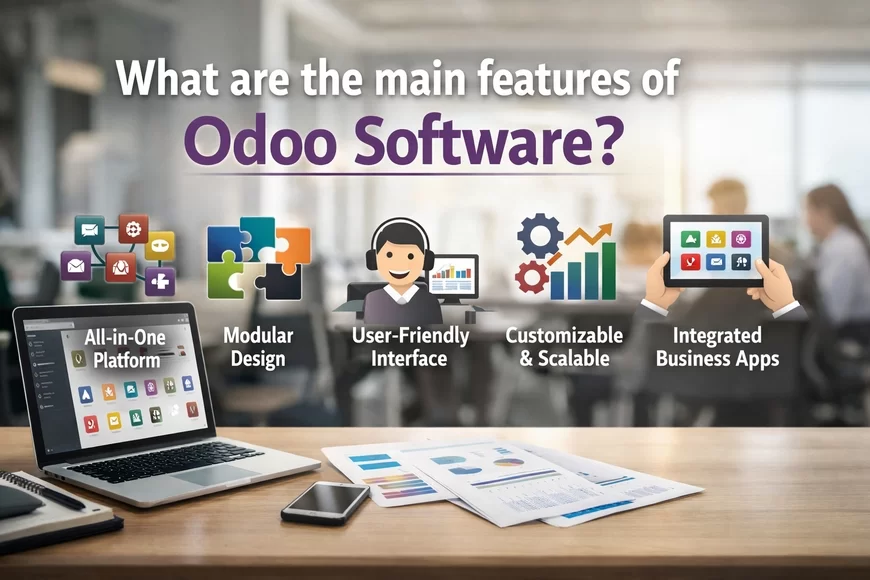
What Are the Main Features of Odoo Software?
A single system designed to reduce operational friction and improve decision clarity
Most businesses don’t struggle because of effort—they struggle because systems don’t talk. Data sits in silos, decisions arrive late, and teams compensate with manual workarounds. Over time, this creates hidden inefficiencies that quietly reduce performance.
Odoo software addresses this by bringing core business functions into a unified environment—so information flows naturally and actions become consistent.
The real value is not “more features.”
It is less confusion, fewer gaps, and stronger execution discipline.
1. Unified Business Applications (All-in-One ERP)
One system. One version of truth.
Odoo integrates multiple business functions into a single platform:
- Sales, CRM, and customer lifecycle
- Inventory, procurement, and supply chain
- Manufacturing and shop-floor execution
- Accounting and financial control
- HR, payroll, and employee management
This eliminates duplication and reduces dependency on disconnected tools.
When data is shared across functions, decisions become faster—and more reliable.
2. Real-Time Data & Reporting
Know what is happening—not what already happened
Odoo provides live dashboards and operational reports across departments:
- Production progress and delays
- Inventory levels and stock movements
- Financial performance and cash flow
- Sales pipeline and order status
This shifts management from reactive to proactive.
You don’t wait for reports—you act on signals as they appear.
3. Workflow Automation
Reduce human dependency in repetitive decisions
Routine processes can be automated based on predefined rules:
- Purchase triggers based on stock levels
- Approval flows for orders, expenses, or changes
- Manufacturing process steps and routing logic
- Invoice creation and payment tracking
Automation reduces manual errors and ensures consistency—especially under pressure.
4. Inventory & Supply Chain Management
Control stock movement with precision
Odoo enables structured inventory control:
- Real-time stock tracking across locations
- Barcode-based operations
- Lot and serial number traceability
- Automated replenishment rules
This improves stock accuracy and reduces both shortages and overstocking.
5. Manufacturing Management (MRP)
Bring discipline to production execution
For manufacturing companies, Odoo provides:
- Bill of Materials (BOM) management
- Work orders and routing control
- Production planning and scheduling
- Quality checks and maintenance tracking
This ensures production runs consistently—with fewer disruptions and better visibility.
6. Integrated Accounting & Finance
Financial clarity without delay
Odoo connects operations directly to finance:
- Automated invoicing and reconciliation
- Expense tracking and approvals
- Tax and compliance support
- Real-time profit and loss visibility
Finance is no longer an isolated function—it reflects actual business activity instantly.
7. User-Friendly Interface
Adoption becomes easier when systems feel natural
Odoo’s interface is designed for practical use:
- Clean dashboards and navigation
- Role-based access for different teams
- Mobile-friendly access for on-the-go decisions
When teams understand the system easily, adoption improves—and resistance reduces.
8. Customization & Integration Flexibility
Adapt the system to your business—not the other way around
Odoo allows controlled customization:
- Extend workflows for unique processes
- Integrate with third-party systems and devices
- Build industry-specific logic when needed
This flexibility ensures long-term relevance without forcing operational compromise.
9. Security & Access Control
Right access for the right role
Odoo supports structured access management:
- Role-based permissions
- Controlled approvals and validations
- Data security across departments
This ensures accountability without restricting productivity.
10. Scalability for Business Growth
Start simple. Expand with control.
Odoo supports gradual growth:
- Add modules as business needs evolve
- Expand users, locations, or operations
- Maintain system consistency during scaling
This reduces the risk of system replacement in the future.
Why These Features Matter in Practice
Because operational clarity is a competitive advantage
When systems are aligned:
- Teams spend less time correcting errors
- Managers make faster, more confident decisions
- Operations become predictable—not reactive
- Growth happens without operational breakdown
The psychological impact is important—
people trust the system, so they stop second-guessing every step.
CTA
If your business feels harder than it should—your system is likely the cause
- Request a practical walkthrough of Odoo features
- Identify where your current process creates friction
- Start with the area that impacts performance most
- Book a Demo session: Contact Us
Core Odoo Service Lines
Choose the service layer that removes the most risk first
- Odoo Consulting: Define workflows, controls, KPIs, and rollout priorities: Odoo Software Consulting Services
- Odoo Implementation: Configure modules, roles, approvals, and reporting structure: Odoo Apps Implementation Services
- Odoo Customization: Extend features without destabilizing the system: Odoo Application Customization Services
- Odoo Integration: Connect data flows across business systems: Odoo Application Integration Services
- Workflow Automation: Reduce delays with controlled automation: Odoo Apps Workflow Automation Services
- Analytics and Reporting: Build KPI reporting that drives action: Odoo Apps Analytics and Reporting Services
- Support and Maintenance: Protect uptime, ad option, and controlled improvements: Odoo Apps Support and Maintenance Services
FAQs
Q1: What is Odoo software used for?
Odoo is an all-in-one ERP platform used to manage sales, inventory, manufacturing, accounting, HR, and more within a single system.
Q2: Is Odoo suitable for small and large businesses?
Yes. Odoo scales from small businesses to large enterprises through modular expansion.
Q3: Can Odoo automate business processes?
Yes. Workflow automation reduces manual effort and improves consistency.
Q4: Does Odoo support manufacturing operations?
Yes. It includes MRP, work orders, BOMs, and quality control features.
Q5: Is Odoo customizable?
Yes. It supports controlled customization and system integrations.