What makes Odoo different from other ERP systems?
Deploy Odoo ERP to unify operations, reduce complexity, and gain real-time control. Compare with traditional ERP and improve decision speed across UAE firms.
 RIbsadmin
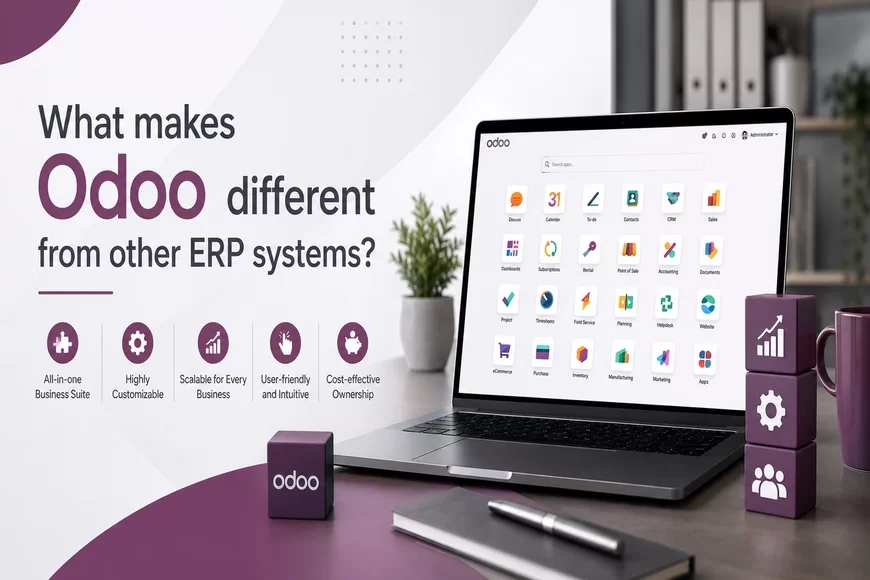
What Makes Odoo Different from Other ERP Systems?
Not all ERP systems reduce complexity—some simply relocate it
Most ERP platforms centralize data but still leave teams working in rigid structures, heavy customization cycles, and slow change processes. The real difference is not features—it is how quickly a system turns operations into clarity, control, and action.
Odoo stands out because it is built around a simple principle: modularity with freedom of execution—so businesses scale without rebuilding the system every time they evolve.
For companies in Dubai, Abu Dhabi, and Sharjah, this means one thing: less system friction, more operational control.
Core Difference: Odoo vs Traditional ERP
Traditional ERP locks processes. Odoo adapts to them.
Legacy ERP systems often require long implementation cycles, heavy consulting dependency, and complex upgrades. Odoo takes a different path—modular apps that can evolve with the business.
Key psychological shift it creates
- From dependency → autonomy in operations
- From static systems → adaptive workflows
- From delayed reporting → real-time decision signals
- From IT-heavy changes → business-driven configuration
Explore ecosystem structure: Odoo ERP Solutions
High-Intent CTA (UAE)
If control feels fragmented, the system—not the people—is usually the constraint
- Request a tailored comparison demo: see Odoo vs your current ERP in real workflows
Book a Demo - Request a process assessment: identify inefficiencies in your current system design
Contact Us
Why Businesses Choose Odoo Over Other ERP Systems
Because flexibility creates speed—and speed creates advantage
Most ERP systems optimize control. Odoo optimizes control + adaptability together, which is why it scales better across fast-changing environments.
What makes the difference operationally
- Modular structure: activate only what you need—no forced full-suite dependency
- Faster implementation cycles: fewer bottlenecks in setup and change requests
- Continuous scalability: add apps without rebuilding the core system
- Unified data model: one source of truth across departments
- Business-led configuration: workflows align with real operations, not templates
This reduces a common ERP failure pattern: system rigidity that slows business growth
Where Traditional ERP Falls Short (and Odoo Fixes It)
The gap is not technology—it is usability under pressure
- Rigid customization models → Odoo allows controlled, incremental configuration
- Slow reporting cycles → real-time dashboards reduce decision lag
- High dependency on consultants → business users can manage workflows
- Disconnected modules → Odoo apps share a unified data structure
- Upgrade disruption → modular architecture reduces system-wide break risk
Explore connected operations: Odoo Supply Chain Management Software
Finance clarity layer: Odoo Finance Accounting Solutions
Business Impact Across UAE Enterprises
The real value is not software—it is decision clarity
Organizations adopting Odoo typically experience:
- Faster operational decisions due to live visibility
- Reduced process delays caused by approval bottlenecks
- Stronger cost control through unified financial + operational data
- Improved execution discipline across teams and departments
This is not just system improvement—it is behavioral alignment across the organization.
Implementation Reality (What Actually Matters)
ERP success depends more on structure than software choice
Even the best system fails without controlled rollout and adoption discipline.
A structured approach includes:
- Workflow mapping aligned to real operations
- Phased deployment to reduce disruption risk
- Role-based training for adoption stability
- KPI-driven validation after each rollout phase
Delivery support:
Odoo Apps Implementation Services
Odoo Software Consulting Services
Why RIBS Technologies
Because ERP success is measured in adoption—not installation
RIBS Technologies focuses on aligning Odoo with real operational behavior so teams actually use the system under pressure—not just during training.
Core Odoo Manufacturing Services
Choose the service layer that strengthens operational control first
- Odoo Consulting: Define workflows, controls, KPIs, and rollout priorities: Odoo Software Consulting Services
- Odoo Implementation: Configure modules, roles, approvals, and reporting structure: Odoo Apps Implementation Services
- Odoo Customization: Extend features without destabilizing the system: Odoo Application Customization Services
- Odoo Integration: Connect data flows across business systems: Odoo Application Integration Services
- Workflow Automation: Reduce delays with controlled automation: Odoo Apps Workflow Automation Services
- Analytics and Reporting: Build KPI reporting that drives action: Odoo Apps Analytics and Reporting Services
- Support and Maintenance: Protect uptime, ad option, and controlled improvements: Odoo Apps Support and Maintenance Services
Learn more: About RIBS Technologies
CTA Block (Dubai, Abu Dhabi, Sharjah)
If your ERP feels slow, fragmented, or rigid—it is limiting decisions, not just processes
- Book an upgrade consultation: Request Demo
- We are the certified: Odoo ERP Partner
- To know more: About RIBS
- Customers who got benefits from us: Clients
FAQs
Q1: Why is Odoo considered different from traditional ERP systems?
A: Odoo is modular and flexible, allowing businesses to adopt only needed apps and scale gradually without heavy system restructuring or long dependency cycles.
Q2: Is Odoo suitable for large enterprises or only SMEs?
A: Odoo supports both. Its modular design allows SMEs to start small and enterprises to scale across multiple departments, locations, and business units.
Q3: Does Odoo require heavy customization like traditional ERP?
A: No. Most configurations are business-driven and modular, reducing the need for complex, long-term custom development compared to legacy ERP systems.
Q4: How does Odoo improve decision-making speed?
A: It provides real-time unified data across departments, reducing reporting delays and enabling faster, more confident operational decisions.