How secure is Odoo ERP?
Learn how Odoo ERP Security supports access control, approvals, audit visibility, and safer operations for UAE businesses.
 RIbsadmin
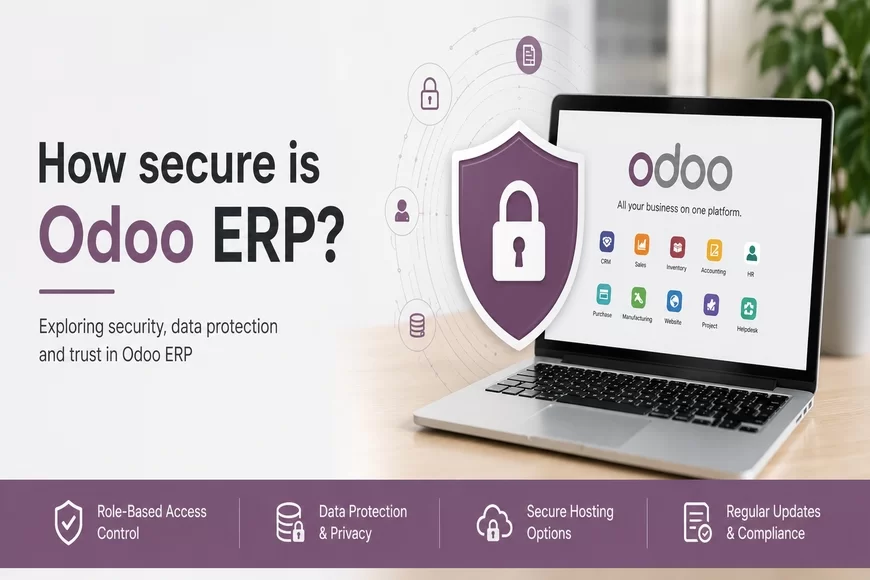
How Secure Is Odoo ERP?
Odoo ERP Security for UAE Businesses
Control access, reduce operational risk, and protect business continuity
ERP security is not only about stopping external threats. Most operational risk comes from uncontrolled access, inconsistent approvals, weak visibility, and fragmented data handling. A secure ERP creates confidence because teams know who changed what, when, and why.
Odoo ERP provides layered security controls designed to support structured operations across finance, inventory, HR, manufacturing, procurement, and customer data—helping organizations reduce avoidable risk while maintaining operational speed.
For companies in Dubai, Abu Dhabi, and Sharjah, the priority is simple: protect data integrity without slowing execution.
What Makes Odoo ERP Secure?
Security becomes stronger when governance is built into daily workflows
Odoo supports role-based access, user permissions, approval workflows, activity tracking, and controlled data visibility. Instead of relying on manual oversight alone, the system helps embed accountability into operations.
Key security strengths
- Role-based access control: users only access the functions relevant to their responsibilities
- Approval governance: structured workflows reduce unauthorized actions
- Audit visibility: activities and operational changes remain traceable
- Controlled data handling: centralized records reduce spreadsheet-related risk
- Secure cloud or on-premise flexibility: deployment aligned to operational requirements
Explore the platform: Odoo ERP Solutions
High-Intent CTA (UAE)
Security is not created by software alone—it is created by disciplined implementation
- Request a security-focused ERP consultation: Contact Us
- Review role structures and approval risks before deployment: Book a Demo
Core Odoo Manufacturing Services
Choose the service layer that strengthens operational control first
- Odoo Consulting: Define workflows, controls, KPIs, and rollout priorities: Odoo Software Consulting Services
- Odoo Implementation: Configure modules, roles, approvals, and reporting structure: Odoo Apps Implementation Services
- Odoo Customization: Extend features without destabilizing the system: Odoo Application Customization Services
- Odoo Integration: Connect data flows across business systems: Odoo Application Integration Services
- Workflow Automation: Reduce delays with controlled automation: Odoo Apps Workflow Automation Services
- Analytics and Reporting: Build KPI reporting that drives action: Odoo Apps Analytics and Reporting Services
- Support and Maintenance: Protect uptime, ad option, and controlled improvements: Odoo Apps Support and Maintenance Services
Strengthen implementation governance with:
Odoo Apps Implementation Services
Security Risks Businesses Commonly Face
Most ERP risks begin with process gaps—not hackers
- Shared logins and weak user governance
- Manual approvals outside the system
- Spreadsheet-based operational dependency
- Uncontrolled customization and access escalation
- Poor visibility into changes and exceptions
A structured ERP setup helps reduce these risks by turning approvals, workflows, and accountability into controlled system behavior.
How RIBS Approaches ERP Security
Stable governance creates long-term trust in the system
RIBS Technologies focuses on practical ERP governance—role mapping, controlled permissions, workflow discipline, and operational visibility—so security supports adoption instead of slowing teams down.
- Role-based implementation structure
- Controlled customization approach
- Traceable operational workflows
- User enablement aligned to accountability
Learn more:
About RIBS Technologies
CTA Block (Dubai, Abu Dhabi, Sharjah)
The safest ERP environment is the one employees consistently trust and use
- Request a procurement-focused demo: Book a Demo
- We are the certified: Odoo ERP Partner
- To know more: About RIBS
- Customers who got benified by us: Clients
FAQs
Q1: Is Odoo ERP secure for business operations?
A: Odoo includes role-based permissions, workflow approvals, user access controls, and activity tracking features that help businesses improve operational security and accountability.
Q2: Can Odoo restrict employee access to sensitive data?
A: Yes. Access can be configured based on roles, departments, responsibilities, and workflow requirements to reduce unnecessary data exposure.
Q3: Does Odoo support audit visibility and traceability?
A: Yes. Operational activities, approvals, and record changes can be tracked to improve accountability and reporting visibility.
Q4: Is cloud-based Odoo secure?
A: Security depends on deployment structure, hosting standards, access governance, backup policies, and implementation discipline. Proper configuration is important for long-term reliability.
Q5: What is the biggest ERP security risk?
A: In many organizations, the biggest risk is uncontrolled processes—shared access, manual approvals, inconsistent data handling, and poor governance visibility.