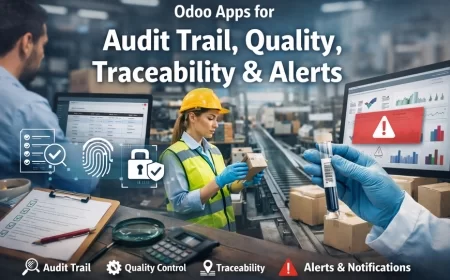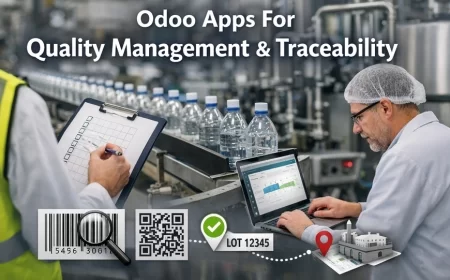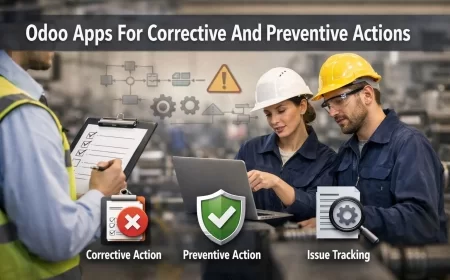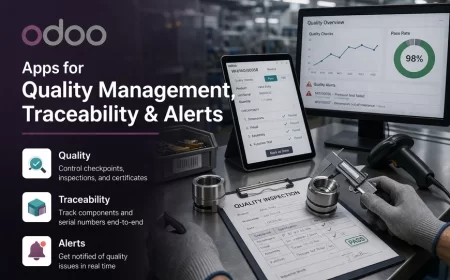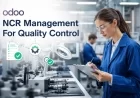
Odoo NCR Management For Quality Control
Control defects with Odoo NCR Management. Track non-conformance, enforce CAPA, and prevent repeat quality issues with full traceability.
 RIbsadmin
Odoo NCR (Non-Conformance Report) Management
Stop repeating quality issues—build a system that learns and prevents
In most factories, quality failures are not rare—they are repeated.
Not because teams ignore them, but because issues are recorded… then forgotten, delayed, or handled inconsistently.
Odoo NCR Management transforms non-conformance handling into a controlled, traceable and accountable process—so defects are not just recorded, but contained, analysed, and prevented.
The shift is simple but powerful:
from “fixing problems” to “eliminating recurrence.”
What NCR Control Really Solves
Uncontrolled quality issues quietly erode trust and margin
Without structured NCR management:
- Issues are raised but not closed
- Root causes are guessed—not proven
- Corrective actions are delayed or incomplete
- The same defects reappear across batches or orders
Odoo introduces discipline where it matters most—after the defect is discovered.
What leadership gains
- Full visibility: every NCR tracked from detection to closure
- Accountability: clear ownership for investigation and action
- Root cause clarity: structured analysis instead of assumptions
- Prevention mindset: issues feed continuous improvement
- Audit confidence: documented evidence for every deviation
Core Capabilities of Odoo NCR Management
Designed to enforce quality discipline without slowing operations
- NCR creation: raise non-conformance from production, quality, or customer complaints
- Categorisation: define defect type, severity, and source
- Traceability linkage: connect NCRs to batches, lots, work orders, or suppliers
- Root cause analysis: structured investigation workflows
- Corrective & preventive actions (CAPA): assign, track, and validate actions
- Approval workflows: controlled closure with verification
- Audit trail: complete history of actions, decisions, and outcomes
The system does not rely on memory—
it forces closure with evidence.
Where NCR Becomes Business-Critical
- Batch manufacturing: recurring defects impact multiple lots
- Customer-driven industries: complaints require traceable resolution
- Regulated environments: audit trails must be complete and reliable
- Supplier-dependent production: incoming quality issues must be controlled
- High-value products: small defects create large financial impact
In these environments, NCR is not optional.
It is risk control.
From Detection to Prevention (NCR Lifecycle)
A structured path that removes uncertainty
- Detect – issue identified in production, QA, or customer feedback
- Record – NCR created with context, evidence, and severity
- Contain – isolate affected stock or production
- Analyse – root cause investigation using structured logic
- Act – corrective and preventive actions assigned
- Verify – actions validated before closure
- Learn – insights fed into process improvement
Each step is controlled.
Each step leaves a trace.
Integrated Quality & Traceability Ecosystem
NCR does not work alone. It is part of a larger control system:
- Quality checks: detect issues early
- Traceability: identify affected batches and materials
- Inventory control: block or quarantine defective stock
- Production workflows: link defects to work orders
- Supplier management: track recurring vendor issues
Together, they create a closed-loop quality system.
Implementation Approach (Practical & Controlled)
Make NCR usable under real production pressure
- Define defect categories and severity levels
- Map NCR workflows to actual plant processes
- Configure root cause and CAPA structures
- Align approval and closure rules
- Train teams on decision-making—not just system use
- Monitor usage to ensure discipline is maintained
The goal is not more data.
The goal is better decisions under pressure.
Why Structured NCR Changes Behaviour
When teams know:
- Issues cannot be ignored
- Actions must be completed
- Closure requires validation
They stop bypassing the system.
They start trusting it.
This is where quality shifts from reactive to controlled and predictable.
CTA – Take Control of Quality Failures
If defects repeat, the system is not learning. Fix the system.
- Request a quality workflow demo aligned to your plant
- Identify recurring defect patterns and control gaps
- Implement NCR discipline where losses are highest
- Book a Demo session: Contact Us
- We are the certified Odoo ERP Partner
Core Odoo Service Lines
Choose the service layer that removes the most risk first
- Odoo Consulting: Define workflows, controls, KPIs, and rollout priorities: Odoo Software Consulting Services
- Odoo Implementation: Configure modules, roles, approvals, and reporting structure: Odoo Apps Implementation Services
- Odoo Customization: Extend features without destabilizing the system: Odoo Application Customization Services
- Odoo Integration: Connect data flows across business systems: Odoo Application Integration Services
- Workflow Automation: Reduce delays with controlled automation: Odoo Apps Workflow Automation Services
- Analytics and Reporting: Build KPI reporting that drives action: Odoo Apps Analytics and Reporting Services
- Support and Maintenance: Protect uptime, ad option, and controlled improvements: Odoo Apps Support and Maintenance Services
FAQs - Odoo NCR (Non-Conformance Report) Management
Q1: What is an NCR in Odoo Manufacturing?
An NCR (Non-Conformance Report) records, tracks, and resolves quality issues with full traceability and accountability.
Q2: Can NCRs be linked to production and inventory?
Yes. NCRs can be connected to work orders, batches, lots, and stock movements.
Q3: Does Odoo support corrective and preventive actions (CAPA)?
Yes. Actions can be assigned, tracked, and validated before NCR closure.
Q4: Is NCR useful for supplier quality issues?
Yes. Supplier-related defects can be tracked and analysed for recurring patterns.
Q5: How does NCR improve audits and compliance?
It creates a complete history of issues, actions, and validations—supporting audit readiness.