Odoo vs SAP Manufacturing ERP Comparison UAE
Compare Odoo vs SAP Manufacturing ERP for UAE manufacturers. Evaluate usability, flexibility, implementation effort, and operational fit.
 RIbsadmin
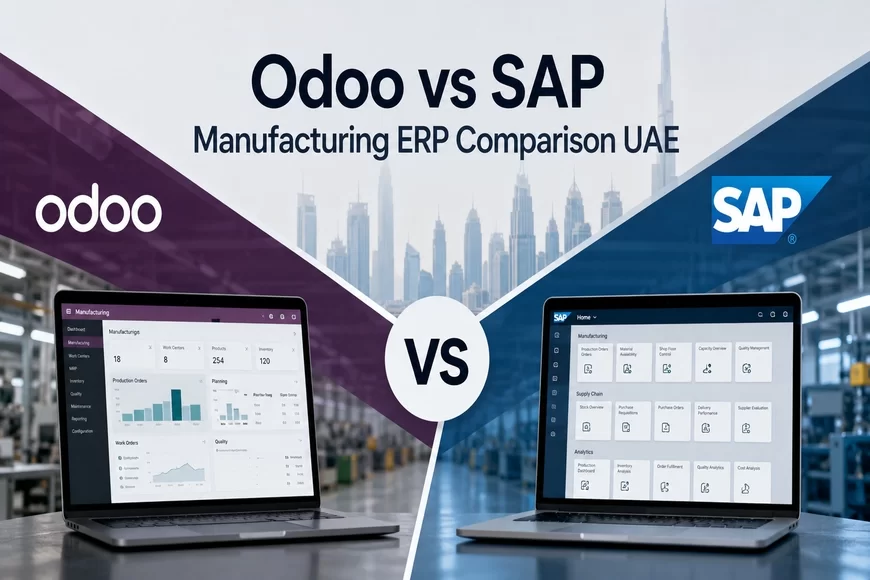
Odoo vs SAP Manufacturing ERP
Choose the ERP that fits your manufacturing reality—not just your requirements list
ERP decisions often create long-term consequences. The wrong choice can increase complexity, slow adoption, and delay business value. The right choice creates confidence, operational visibility, and a foundation for controlled growth.
For many manufacturers in Dubai, Abu Dhabi, and Sharjah, the comparison is not about which platform has more features. The real question is:
Which ERP can deliver the control, usability, and scalability your organisation actually needs?
Understanding the Difference
Both Odoo Manufacturing ERP and SAP manufacturing solutions support production planning, inventory control, procurement, quality processes, and financial management.
The difference is often found in implementation complexity, flexibility, user adoption, and total ownership effort.
Organizations typically evaluate:
- Implementation effort
- Process flexibility
- User adoption
- Reporting visibility
- Customization requirements
- Growth and scalability needs
- Long-term operational ownership
Why Many Growing Manufacturers Consider Odoo
Manufacturers seeking operational discipline without excessive complexity often evaluate Odoo because it provides an integrated platform across production, inventory, quality, maintenance, procurement, sales, and finance.
Key advantages often considered
- Unified platform: One ecosystem across business functions.
- Real-time visibility: Faster access to operational information.
- Faster deployment potential: Depending on scope and governance.
- Process flexibility: Adapt workflows to operational realities.
- User-friendly experience: Supports broader team adoption.
- Lower ownership complexity: Particularly for small and mid-sized manufacturers.
Explore: Odoo Manufacturing ERP, Odoo Supply Chain Management, and Odoo Finance Accounting Solutions.
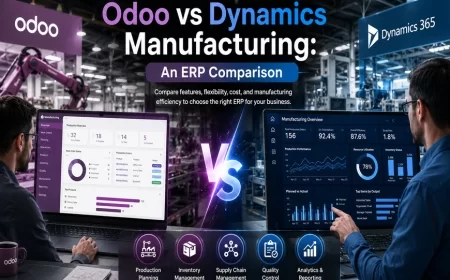
Odoo vs SAP Manufacturing: Practical Comparison
| Evaluation Area | Odoo Manufacturing ERP | SAP Manufacturing Solutions |
|---|---|---|
| User Experience | Modern and intuitive | Often requires deeper training |
| Deployment Approach | Flexible and phased | Typically more structured and extensive |
| Customization | Flexible configuration options | Extensive but often more complex |
| SME Fit | Commonly considered by SMEs and mid-market firms | Frequently selected by large enterprises |
| Implementation Complexity | Generally lower depending on scope | Often higher depending on business requirements |
| Adoption Curve | Typically easier for operational teams | May require longer adoption periods |
| Total Ownership Effort | Often lower for growing businesses | Can be higher for larger environments |
Every ERP selection should be based on business requirements, governance needs, industry complexity, and growth plans.
When Odoo May Be a Strong Fit
Odoo is often considered when organizations want:
- Faster operational visibility
- Connected manufacturing and inventory processes
- Controlled customization
- Phased implementation strategy
- Improved user adoption
- Multi-site growth without excessive complexity
Particularly valuable for manufacturers seeking to reduce spreadsheet dependency and improve execution discipline.
When SAP May Be Considered
SAP is often evaluated by organizations with:
- Large enterprise structures
- Extensive global operations
- Highly complex governance requirements
- Large-scale multi-country environments
- Significant internal ERP administration capabilities
The best choice depends on operational maturity, process complexity, and long-term strategic objectives.
Selection Factors That Matter Most
Before selecting any ERP, manufacturers should assess:
- Current process maturity
- Data quality readiness
- Reporting requirements
- Internal change management capability
- User adoption expectations
- Budget and ownership considerations
- Future scalability requirements
A structured ERP evaluation reduces decision risk and increases implementation success.
Implementation Matters More Than Software
Even the strongest ERP platform can struggle if implementation lacks governance, process alignment, or user adoption.
Successful projects typically include:
- Discovery and process mapping
- Fit-gap analysis
- Controlled configuration
- Data validation
- User acceptance testing
- Training and adoption support
- Post-go-live stabilization
The objective is not simply software deployment—it is sustainable operational improvement.
Why RIBS Technologies
RIBS Technologies helps manufacturers evaluate ERP options through a structured, business-focused approach.
Core Odoo Manufacturing Services
Choose the service layer that strengthens operational control first
- Odoo Consulting: Define workflows, controls, KPIs, and rollout priorities: Odoo Software Consulting Services
- Odoo Implementation: Configure modules, roles, approvals, and reporting structure: Odoo Apps Implementation Services
- Odoo Customization: Extend features without destabilising the system: Odoo Application Customization Services
- Odoo Integration: Connect data flows across business systems: Odoo Application Integration Services
- Workflow Automation: Reduce delays with controlled automation: Odoo Apps Workflow Automation Services
- Analytics and Reporting: Build KPI reporting that drives action: Odoo Apps Analytics and Reporting Services
- Support and Maintenance: Protect uptime, ad option, and controlled improvements: Odoo Apps Support and Maintenance Services
The focus remains on operational outcomes, adoption, and measurable business value.
CTA Block - Odoo vs SAP Manufacturing ERP
ERP decisions shape operational performance for years. Choose with confidence.
- Book a demo: Contact RIBS Technologies
- We are the certified: Odoo ERP Partner
- To know more: About RIBS
- Customers who got benefits from us: Clients
FAQs - Odoo vs SAP Manufacturing ERP
Q1: Is Odoo a replacement for SAP in manufacturing?
A: It depends on organizational size, complexity, governance requirements, and growth plans. Both platforms serve different business contexts.
Q2: Is Odoo suitable for manufacturing companies in the UAE?
A: Odoo is widely considered by manufacturers seeking integrated production, inventory, quality, and financial visibility within a unified platform.
Q3: Which ERP is easier for employees to adopt?
A: Adoption depends on implementation quality, training, and process design. Many organizations find intuitive workflows beneficial for faster user acceptance.
Q4: Is SAP always better for large manufacturers?
A: Not necessarily. ERP selection should align with operational requirements, governance complexity, and long-term business objectives.
Q5: What should be evaluated before choosing an ERP?
A: Process maturity, reporting needs, scalability, user adoption expectations, implementation scope, and ownership effort are important considerations.