Odoo ERP Readiness Assessment for Manufacturers in UAE
Evaluate Odoo ERP Readiness Assessment requirements for manufacturing operations. Identify risks, data gaps, and priorities before implementation.
 RIbsadmin
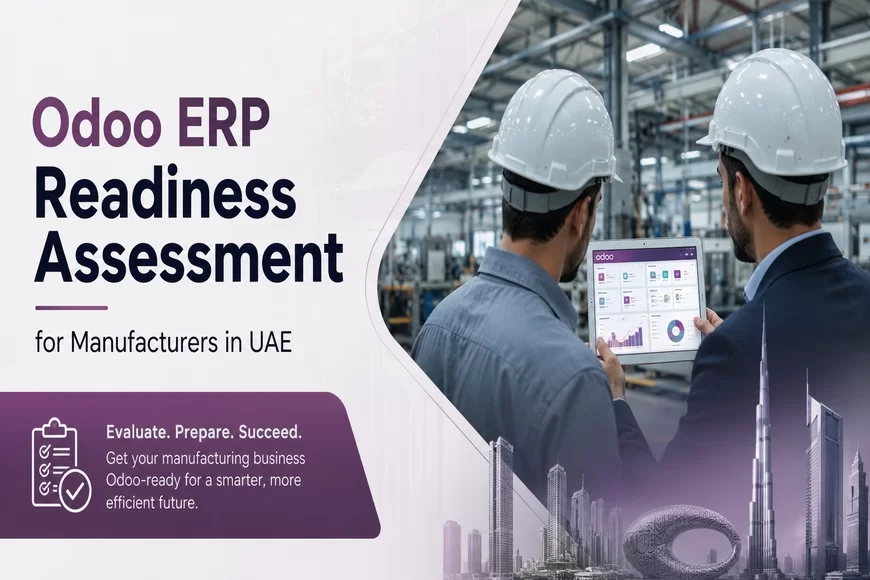
Odoo Manufacturing ERP Readiness Assessment for UAE Manufacturers
Reduce implementation risk before committing time, budget, and resources
Many ERP projects struggle not because the software is wrong, but because the organization is not fully prepared for the change. An Odoo Manufacturing ERP Readiness Assessment helps identify process gaps, data risks, reporting requirements, governance needs, and adoption challenges before implementation begins.
For manufacturers in Dubai, Abu Dhabi, and Sharjah, readiness creates a powerful advantage: fewer surprises, stronger adoption, and better decision confidence from day one.
What Is an ERP Readiness Assessment?
A readiness assessment evaluates whether your factory has the operational foundation required for a successful ERP rollout.
Instead of asking, "Can we implement Odoo?", the better question is:
Are we prepared to achieve measurable value from Odoo?
The assessment focuses on:
- Process maturity: production, inventory, quality, procurement, and maintenance workflows
- Reporting requirements: KPI visibility and management expectations
- Data quality: master data, BOMs, routings, inventory records, and historical information
- User readiness: roles, responsibilities, and change adoption risks
- Governance controls: approvals, accountability, and compliance requirements
High-Intent CTA (UAE)
The lowest-cost mistake is the one discovered before implementation begins
- Request an ERP Readiness Assessment: identify risks before they become project delays
- Schedule a consultation: validate scope, priorities, and implementation readiness
Why Readiness Matters for Manufacturing ERP
Manufacturing environments contain hundreds of interconnected decisions. If master data, workflows, or ownership structures are unclear, ERP implementation becomes slower and more expensive.
Benefits of a readiness assessment
- Reduced project risk: identify gaps before configuration begins
- Clear implementation priorities: focus on what delivers value first
- Better data confidence: reduce migration issues and reporting errors
- Stronger user adoption: clarify expectations and responsibilities early
- Improved budget predictability: minimize unexpected scope expansion
Key Assessment Areas
A practical review of the control points that influence ERP success
- Production planning and execution
- Inventory accuracy and traceability
- Quality management processes
- Maintenance and asset reliability
- Procurement and supplier workflows
- Costing and financial reporting
- Approval structures and governance
- Management reporting and KPI visibility
Common Manufacturing Readiness Challenges
Many factories share similar obstacles before ERP deployment:
- Production processes vary between departments
- BOMs and routings are incomplete or outdated
- Inventory records lack consistency
- Quality documentation is difficult to trace
- Reporting relies heavily on spreadsheets
- Decision-making depends on individual knowledge
Identifying these risks early often improves implementation confidence and reduces disruption.
Assessment Outcomes
At the end of the assessment, manufacturers typically gain:
- Current-state visibility
- Future-state process recommendations
- Data readiness observations
- Implementation risk overview
- Priority roadmap for deployment
- Suggested rollout approach
The goal is not complexity. The goal is clarity.
How RIBS Conducts ERP Readiness Assessments
A structured review helps transform assumptions into measurable facts.
Typical approach
- Discovery workshops
- Process mapping
- Stakeholder interviews
- Data and reporting review
- Risk identification
- Readiness scorecard and recommendations
This creates a practical foundation for future implementation planning.
Why RIBS Technologies
ERP success begins before configuration starts.
RIBS Technologies helps manufacturers evaluate operational readiness, governance requirements, reporting expectations, and adoption risks before implementation decisions are finalized.
Core Odoo Manufacturing Services
Choose the service layer that strengthens operational control first
- Odoo Consulting: Define workflows, controls, KPIs, and rollout priorities: Odoo Software Consulting Services
- Odoo Implementation: Configure modules, roles, approvals, and reporting structure: Odoo Apps Implementation Services
- Odoo Customization: Extend features without destabilising the system: Odoo Application Customization Services
- Odoo Integration: Connect data flows across business systems: Odoo Application Integration Services
- Workflow Automation: Reduce delays with controlled automation: Odoo Apps Workflow Automation Services
- Analytics and Reporting: Build KPI reporting that drives action: Odoo Apps Analytics and Reporting Services
- Support and Maintenance: Protect uptime, ad option, and controlled improvements: Odoo Apps Support and Maintenance Services
CTA Block - Odoo Manufacturing ERP Readiness Assessment f
The strongest ERP projects start with clarity, not assumptions
- Book a demo: Contact RIBS Technologies
- We are the certified: Odoo ERP Partner
- To know more: About RIBS
- Customers who got benefits from us: Clients
FAQs - Odoo Manufacturing ERP Readiness Assessment f
Q1: What is an Odoo Manufacturing ERP Readiness Assessment?
A: It is a structured review of processes, data, governance, reporting, and user readiness to help reduce implementation risk before deployment.
Q2: Who should participate in the assessment?
A: Typically leadership, operations, production, quality, supply chain, finance, and key process owners.
Q3: Does the assessment include data review?
A: Yes. Master data, BOMs, inventory records, and reporting structures are commonly evaluated.
Q4: Can readiness assessments reduce project risk?
A: They help identify potential risks and gaps early, allowing organizations to address them before implementation begins.
Q5: Is the assessment useful for multi-site manufacturers?
A: Yes. It can help identify process variations, reporting requirements, and governance considerations across locations.