Why do businesses choose Odoo ERP?
Discover Why Choose Odoo ERP for unified control, real-time decisions, and scalable growth. Reduce complexity and improve execution with one system.
 RIbsadmin

Why Do Businesses Choose Odoo ERP?
Because control, clarity, and consistency outperform complexity every time
Most businesses don’t fail due to lack of effort. They struggle because systems don’t align. Data lives in silos, teams rely on assumptions, and decisions arrive too late. Over time, this creates hidden cost, operational friction, and leadership fatigue.
Odoo ERP changes that dynamic. It replaces scattered tools with a unified, disciplined system—where every department works from the same version of reality.
The shift is subtle at first. Then it becomes powerful.
Decisions speed up. Errors reduce. Execution stabilises.
What Drives Businesses to Move to Odoo
From reactive management to controlled execution
Businesses typically choose Odoo when:
- Multiple systems create inconsistent data
- Manual processes slow down execution
- Reporting lacks real-time accuracy
- Teams depend too much on individuals, not systems
- Growth exposes process gaps and inefficiencies
Odoo addresses these by removing uncertainty at the system level—not just improving visibility.
Core Reasons Businesses Choose Odoo ERP
1. One System. One Truth.
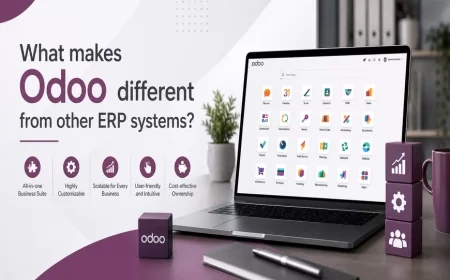
Sales, operations, finance, inventory, HR, and CRM operate on a single integrated platform. This eliminates duplication, reduces errors, and builds trust in data.
2. Simplicity Without Losing Power
Odoo balances usability and depth. Teams adopt it faster because workflows feel logical, not forced.
3. Real-Time Decision Confidence
Dashboards, reports, and live data ensure decisions are based on current reality—not outdated reports.
4. Scalable by Design
Start with essential modules. Expand as operations grow. This reduces upfront risk and avoids system overload.
5. Cost Efficiency Over Time
Compared to fragmented systems or heavy enterprise ERPs, Odoo offers better control over total cost of ownership.
Psychological Advantage: Why Leaders Prefer Odoo
Beyond features, Odoo solves something deeper—
decision anxiety.
When systems are inconsistent, leaders hesitate. They double-check, delay, or rely on instinct.
Odoo reduces that mental friction by making outcomes predictable and visible.
- You trust your numbers
- You trust your processes
- Your team trusts the system
That trust compounds into faster execution and stronger performance.
How Odoo Impacts Daily Operations
- Sales: faster quotations, clearer pipeline visibility
- Inventory: accurate stock, reduced surprises
- Manufacturing: controlled production and costing
- Finance: real-time financial position and compliance
- HR: structured employee data and workflows
The system quietly enforces discipline—
so teams don’t have to “figure things out” every day.
Adaptability Without Chaos
Flexible—but not uncontrolled
Odoo allows configuration and controlled customization to match business needs.
However, successful adoption comes from governed implementation, not unlimited changes.
The goal is not to fit every preference—
but to standardize what truly drives performance.
Implementation Mindset That Works
Choosing Odoo is only the first step.
The real value comes from how it is implemented.
A stable approach includes:
- Clear process mapping before setup
- Role-based workflows and responsibilities
- Data accuracy and migration validation
- Controlled rollout and user training
- Continuous monitoring and improvement
This ensures Odoo becomes a working system—not just software installed.
CTA
If your business depends on consistent execution—your system must enforce it
- Evaluate your current operational gaps
- Identify where decisions slow down
- Understand how a unified ERP can remove friction
- Book a Demo session: Contact Us
Core Odoo Service Lines
Choose the service layer that removes the most risk first
- Odoo Consulting: Define workflows, controls, KPIs, and rollout priorities: Odoo Software Consulting Services
- Odoo Implementation: Configure modules, roles, approvals, and reporting structure: Odoo Apps Implementation Services
- Odoo Customization: Extend features without destabilizing the system: Odoo Application Customization Services
- Odoo Integration: Connect data flows across business systems: Odoo Application Integration Services
- Workflow Automation: Reduce delays with controlled automation: Odoo Apps Workflow Automation Services
- Analytics and Reporting: Build KPI reporting that drives action: Odoo Apps Analytics and Reporting Services
- Support and Maintenance: Protect uptime, ad option, and controlled improvements: Odoo Apps Support and Maintenance Services
FAQs
Q1: Why is Odoo ERP popular among growing businesses?
It combines flexibility, integration, and cost control in a single platform.
Q2: Is Odoo suitable for multiple industries?
Yes. It supports manufacturing, trading, services, and more.
Q3: Can Odoo replace multiple systems?
Yes. It integrates core business functions into one system.
Q4: Is Odoo scalable as business grows?
Yes. Modules can be added as needs expand.
Q5: Does Odoo improve decision-making?
Yes. Real-time data improves speed and accuracy of decisions.