How Odoo Improved Compliance & Traceability for a Regulated Industry
Improve audits, traceability, and operational control using Odoo Compliance & Traceability workflows for regulated industries across the UAE.
 RIbsadmin
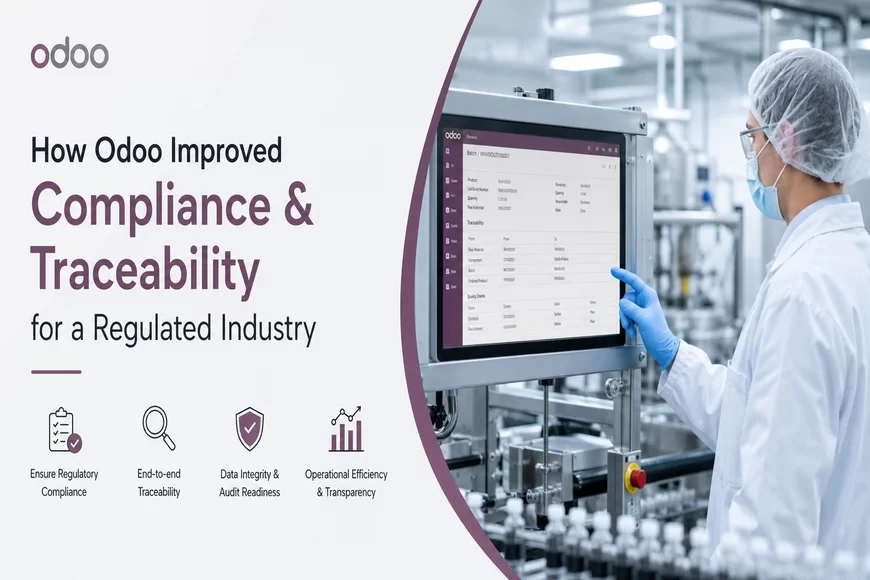
How Odoo Improved Compliance & Traceability for a Regulated Industry
From Manual Evidence to Controlled Traceability
When compliance depends on memory, risk increases quietly
In regulated industries, compliance failures rarely begin with one major mistake. They usually start with small gaps—missing batch records, delayed approvals, incomplete quality checks, disconnected spreadsheets, or inventory movements that cannot be verified quickly. Over time, these gaps reduce confidence, slow audits, and increase operational pressure.
Using Odoo Manufacturing ERP, the organization replaced fragmented processes with a connected system for production, inventory, quality, maintenance, and traceability. The result was not just better reporting—it was greater operational confidence under pressure.
The Compliance Challenge
Too many systems. Too little visibility.
The company operated in a highly regulated environment where traceability, approvals, and quality evidence were essential. However, critical processes relied on spreadsheets, emails, and manual coordination.
Common operational risks included
- Incomplete lot and serial traceability
- Delayed quality approvals and missing inspection records
- Difficulty retrieving audit evidence quickly
- Inventory discrepancies between departments
- Limited visibility into production exceptions and rework
Leadership recognized that growth without stronger controls would increase risk exposure—not reduce it.
How Odoo Strengthened Control and Traceability
One connected workflow replaced fragmented execution
The implementation focused on creating structured workflows that reduced dependency on manual follow-ups and disconnected records.
Key improvements included
- Lot and serial traceability: improved visibility across receiving, production, and dispatch
- Quality checkpoints: inspection records and alerts captured within workflows
- Approval governance: controlled access and role-based accountability
- Centralized reporting: operational and compliance data aligned in one system
- Inventory accuracy: barcode-enabled stock movement and validation discipline
Supporting operational areas were connected using Odoo Supply Chain Management Software and Odoo Finance Accounting Solutions.
Business Outcomes Observed
Compliance became easier because execution became structured
Instead of reacting to missing information during audits or customer reviews, teams gained faster access to operational truth.
Operational improvements included
- Faster retrieval of traceability records
- Reduced dependency on manual spreadsheets
- Better visibility into quality exceptions
- Improved confidence in inventory accuracy
- More consistent reporting across departments
The most important shift was psychological: teams moved from “hoping records exist” to knowing evidence is available when needed.
Implementation Approach
Controlled rollout designed for operational continuity
The project followed a phased approach focused on governance, adoption, and stability.
- Workflow mapping and fit-gap analysis
- Role-based approvals and access controls
- Data migration and validation
- User training and UAT execution
- Go-live stabilization and support
Implementation services:
Odoo Apps Implementation Services
Odoo Software Consulting Services
Why RIBS Technologies
Because regulated industries require discipline—not just software
RIBS Technologies focuses on structured ERP delivery that improves traceability, governance, and operational visibility without creating unnecessary complexity.
- Odoo Consulting: Define workflows, controls, KPIs, and rollout priorities: Odoo Software Consulting Services
- Odoo Implementation: Configure modules, roles, approvals, and reporting structure: Odoo Apps Implementation Services
- Odoo Customization: Extend features without destabilizing the system: Odoo Application Customization Services
- Odoo Integration: Connect data flows across business systems: Odoo Application Integration Services
- Workflow Automation: Reduce delays with controlled automation: Odoo Apps Workflow Automation Services
- Analytics and Reporting: Build KPI reporting that drives action: Odoo Apps Analytics and Reporting Services
- Support and Maintenance: Protect uptime, ad option, and controlled improvements: Odoo Apps Support and Maintenance Services
Industry delivery proof: Clients
CTA Block (Dubai, Abu Dhabi, Sharjah)
If compliance pressure is increasing, visibility must improve first
- Request a procurement-focused demo: Book a Demo
- We are the certified: Odoo ERP Partner
- To know more: About RIBS
- Customers who got benified by us: Clients
FAQs
Q1: How does Odoo improve traceability in regulated industries?
A: Odoo supports lot and serial tracking, workflow approvals, and centralized records—helping businesses improve visibility across inventory, production, and quality processes.
Q2: Can Odoo support audit and compliance readiness?
A: Yes. Structured workflows and traceable records help teams retrieve operational evidence faster during audits and customer reviews.
Q3: What industries typically need stronger traceability controls?
A: Food manufacturing, chemicals, pharmaceuticals, medical products, and regulated industrial sectors commonly require stronger quality and traceability governance.
Q4: What impacts implementation complexity?
A: Complexity usually depends on process variation, compliance depth, integrations, data quality, reporting requirements, and number of operational sites.
Q5: Can implementation be phased to reduce operational disruption?
A: Yes. Many organizations start with critical workflows first, then expand in controlled phases after stabilization.