Switch From Manual Processes to Full Automation with Odoo ERP
A real Odoo ERP Implementation success story—showing how a UAE company moved from manual processes to full automation, visibility, and control.
 RIbsadmin
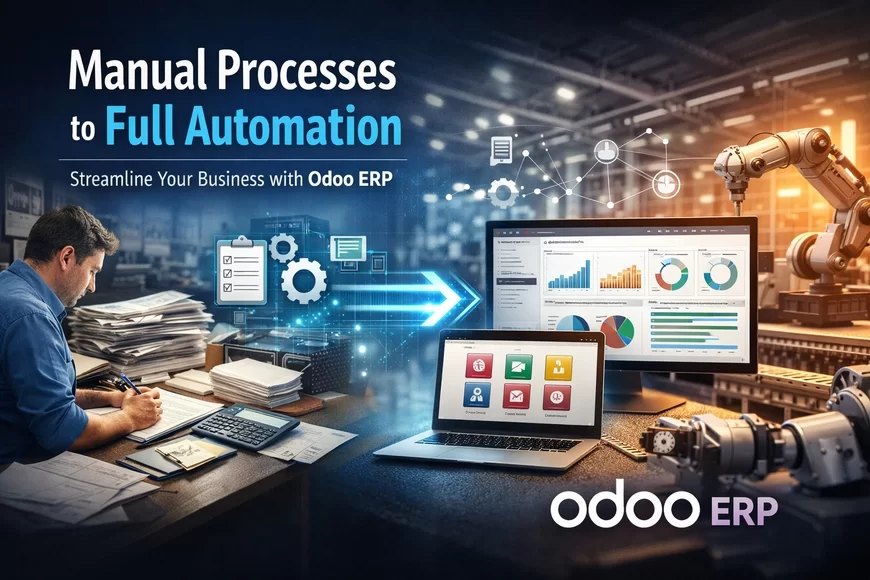
Odoo ERP Implementation Success: From Manual Processes to Full Automation
From Manual Chaos to Operational Clarity
Every growing business eventually reaches a turning point—where spreadsheets, approvals via messaging apps, and manual reconciliations no longer keep up with customer demand. This success story highlights how a UAE-based company transformed its manual, fragmented processes into a fully automated, audit-ready operating system using Odoo ERP.
The shift wasn’t just technological—it was psychological. The organization moved from “we assume” to “we know”, from firefighting to controlled execution, and from reactive corrections to predictable performance.
The Starting Challenge: Visibility, Control, and Speed
Before Odoo, the company faced:
- Unpredictable operations because data lived in multiple tools
- Delayed decision cycles caused by unclear ownership
- Repeated errors in inventory, orders, costing, and reporting
- No real accountability, only best-effort coordination
- Zero traceability, making audits and investigations slow
Leadership wanted certainty, teams wanted clarity, and customers demanded consistency.
Odoo became the enabler.
The Odoo Transformation Journey
1. Unified Platform → Real-Time Truth
All departments migrated into one ERP—ending duplicate entries, manual reconciliations, and version confusion. Everyone finally worked from the same verified data.
2. Automated Workflows → Faster Decisions
Approvals, routing, planning, procurement, invoicing, and reporting became automated.
No more chasing updates.
No more delays due to unclear responsibilities.
3. Inventory & Procurement Control → Zero Guesswork
Barcode execution, stock validation, RFQ automation, vendor governance—
Procurement became a controlled, predictable cycle supported by data and rules.
4. Accuracy in Finance → Better Margin Protection
Finance gained consistency in valuation, costing, month-end reporting, and evidence trails—
leading to higher confidence in numbers used for decision-making.
5. Cross-Team Collaboration → Less Noise, More Action
Tasks, alerts, responsibilities, and KPIs became visible and measurable.
Teams now aligned because the system aligned them.
Results Achieved Within Months
- 60–80% reduction in manual work
- 20–40% faster approvals and task completion
- Stronger audit readiness with digital traceability
- Higher customer satisfaction from dependable operations
- More confident leadership decisions backed by real-time metrics
Most importantly:
The system became the standard—not individual memory or effort.
Why Odoo Enabled This Transformation
- Modular → Start small, expand at the right pace
- Unified → No more fragmented tools
- Structured → Built-in approvals, controls, and workflows
- Scalable → Supports multi-company, multi-branch, multi-entity
- User-friendly → Faster adoption with lower resistance
- Cost-effective → Enterprise capabilities without enterprise pricing
Implementation Approach (Risk-Controlled, E-E-A-T Based)
- Discovery & Blueprint: map processes, remove ambiguity
- Configuration & Controls: workflows, roles, governance
- Data Migration: clean, validated, reconciled
- User Training & UAT: practical, role-based, scenario-focused
- Go-Live & Hypercare: stabilize, optimise, reinforce
- Continuous Improvement: add modules only when KPIs are stable
This structured approach ensures trust, adoption, and measurable value.
CTA Block
If you want transformation, you must design for control—not hope for it
- Request a procurement-focused demo: Book a Demo
- We are the certified: Odoo ERP Partner
- To know more: About RIBS
- Customers who got benified by us: Clients
FAQs
Q1: How long does a full Odoo ERP implementation take?
A: Typically 8–20 weeks depending on modules, data readiness, and cross-team dependencies.
Q2: Does Odoo support phased rollouts?
A: Yes. You can start with one department and expand without disrupting operations.
Q3: Will teams adapt quickly to Odoo ERP?
A: Adoption is faster because workflows are intuitive and reduce manual burden.
Q4: What makes Odoo suitable for UAE businesses?
A: VAT compliance, multi-company readiness, approval governance, and scalable structure.
Q5: What affects implementation cost?
A: User count, module selection, customization, integrations, data quality, and support needs.