Odoo ERP Manufacturing Integrations in UAE
Deploy Odoo Manufacturing Integrations to connect warehouse, finance, sales, and shop-floor systems. Reduce delays and improve data trust in UAE.
 RIbsadmin
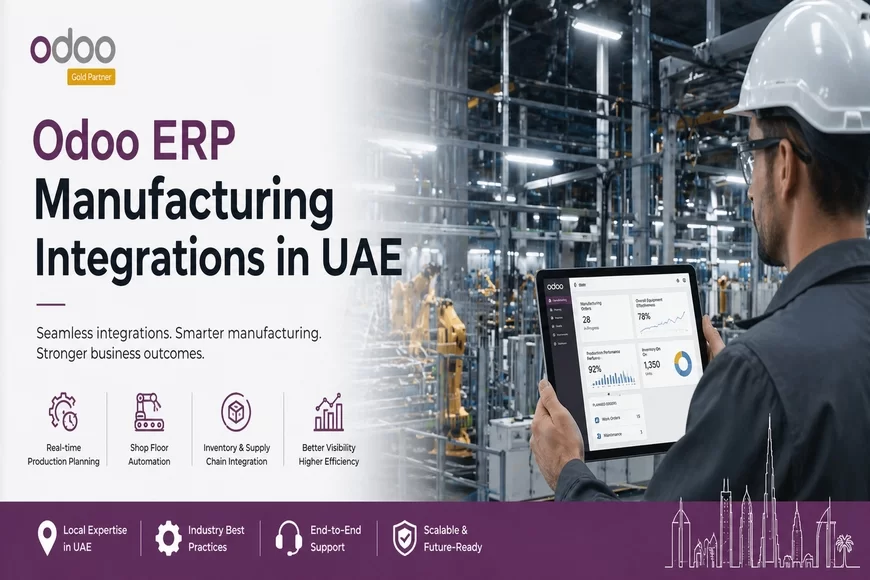
Odoo Manufacturing Integrations for UAE Operations
Connect critical systems without losing control, speed, or data trust
Disconnected systems create silent costs—duplicate entries, delayed updates, reporting conflicts, and decisions made on outdated information. Odoo Manufacturing Integrations help connect ERP with warehouse tools, barcode devices, finance systems, eCommerce, machines, and external platforms—so information moves faster, errors reduce, and teams act with greater confidence.
For manufacturers in Dubai, Abu Dhabi, and Sharjah, integration is not just technical—it is a control strategy.
Why Integrations Matter in Manufacturing
When systems speak clearly, teams move faster
Factories often run multiple tools across procurement, production, logistics, finance, and customer operations. Without integration, people spend time reconciling instead of improving performance.
What leaders gain through structured integrations
- Shared visibility: One connected flow across departments
- Faster execution: Less waiting for manual updates
- Better reporting confidence: Fewer mismatched numbers
- Lower process risk: Reduced manual re-entry errors
- Scalable growth: Add systems without creating chaos
Explore core platform options: Odoo ERP Solutions
High-Intent CTA (UAE)
Turn isolated tools into one coordinated operating model
- Request an integration assessment: Book a Demo
- Discuss priorities and risks: Contact Us
Common Odoo Manufacturing Integrations
Connect where friction is highest first
- Warehouse systems: scanners, barcode devices, label printing
- Finance systems: banking flows, reporting, accounting alignment
- Sales channels: eCommerce orders and customer data sync
- Shop-floor tools: tablets, terminals, selected machine signals
- Logistics partners: dispatch updates and shipment status
- Document flows: approvals, records, controlled sharing
Business Outcomes of Smart Integrations
Reduce friction. Increase confidence. Protect margins.
- Faster order-to-production handovers
- Cleaner stock and procurement visibility
- Lower manual workload for teams
- Improved traceability across systems
- Stronger month-end reporting confidence
- Better customer response speed
Manufacturing Use Cases
Practical integrations that create daily value
- Procurement: supplier data, RFQ flow, PO visibility
- Production: job status updates, material movement signals
- Warehouse: receiving, picking, transfer accuracy
- Finance: invoice flow, costing data, reconciliations
- Service: warranty history, support visibility, spare parts control
Integration Delivery Approach
Control first. Then connection.
Strong integrations begin with process clarity, not coding speed.
- Discovery: systems map, data flow review, priorities
- Design: secure logic, field mapping, exception rules
- Build: APIs, connectors, controlled automation
- Testing: scenarios, accuracy checks, failure handling
- Go-live: monitored rollout with minimal disruption
- Optimize: refine speed, reliability, reporting value
Related services: Odoo Application Integration Services and Odoo Apps Implementation Services
Security and Governance Mindset
Because connected systems need trusted boundaries
- Role-based access control
- Approved data flow logic
- Error logging and traceability
- Controlled change management
- Practical backup and continuity planning
Why RIBS Technologies
Because stable integrations create trust—and trust drives adoption
RIBS Technologies is an ISO 9001:2015-certified software development company supporting structured ERP and integration delivery across UAE businesses.
- Finance & accounting: invoicing discipline and reporting confidence with Odoo Finance Process Applications
- Sales operations: pipeline clarity and order consistency with Odoo Sales Applications
- Supply chain: procurement and inventory accuracy with Odoo Supply Chain Applications
- HR & governance: standardised workflows and approvals with Odoo Human Resources Applications
- Services & delivery: accountability for projects and services using Odoo Services Applications
- Productivity & approvals: enforce ownership with Odoo Productivity Applications
Learn more: About RIBS Technologies
CTA Block - Odoo Manufacturing Integrations for UAE Operations
If systems are slowing growth, connection becomes an advantage
- Book a demo: Request Demo
- We are the certified: Odoo ERP Partner
- To know more: About RIBS
- Customers who got benified by us: Clients
FAQs - Odoo Manufacturing Integrations for UAE Operations
Q1: What systems can Odoo Manufacturing integrate with?
A: Common integrations include barcode tools, finance systems, eCommerce, logistics platforms, and selected shop-floor tools.
Q2: How long do integrations take?
A: Timelines depend on systems involved, data quality, API readiness, and testing scope.
Q3: Can integrations reduce manual work?
A: Yes. Well-designed integrations often reduce duplicate entry and improve update speed.
Q4: Are integrations secure?
A: Security depends on access controls, approved workflows, and monitored data handling.
Q5: Should all systems be integrated at once?
A: Usually no. Many businesses start with the highest-impact workflows first.