RASCi Roles in Odoo Implementation
Define RASCi Roles in Odoo Implementation to remove delays, clarify accountability, and accelerate ERP execution across UAE manufacturing teams.
 RIbsadmin
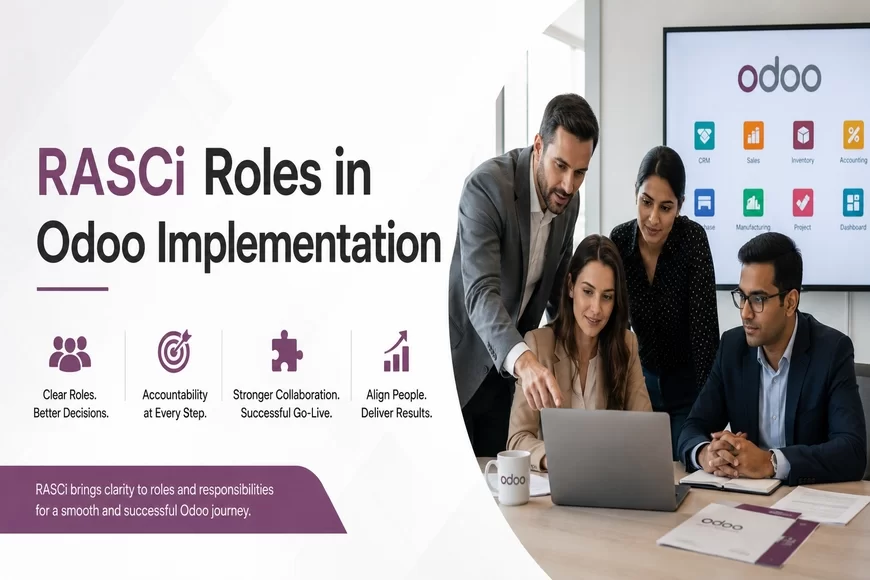
RASCi Roles in Odoo Manufacturing Implementation
Clarity of ownership is the fastest way to reduce execution risk
ERP projects rarely fail because of technology. They fail when decisions stall, responsibilities overlap, and accountability is unclear. RASCi (Responsible, Accountable, Support, Consulted, Informed) introduces structured ownership—so every task, approval, and escalation is clearly defined before execution begins.
For manufacturers in Dubai, Abu Dhabi, and Sharjah, this means fewer delays, faster decisions, and controlled implementation momentum.
What RASCi Solves in ERP Projects
Replace ambiguity with controlled responsibility
When roles are unclear, teams hesitate, approvals slow down, and rework increases. RASCi removes this friction by assigning ownership at every stage of implementation—so actions move forward without dependency confusion.
What leadership gains
- Decision clarity: one accountable owner per task—no overlaps, no confusion
- Faster execution: fewer approval bottlenecks and escalation delays
- Structured accountability: roles tied to outcomes, not assumptions
- Measurable governance: progress tracked with ownership visibility
- Reduced project risk: fewer missed steps and uncontrolled changes
High-Intent CTA (UAE)
If ownership is unclear, delays are guaranteed
- Define RASCi roles early: align teams before execution begins Book a Demo
- Request a structured implementation plan: Contact Us
Why RASCi Matters in Odoo Manufacturing Implementation
Because execution speed depends on decision ownership
ERP implementation involves multiple stakeholders—production, quality, finance, IT, procurement. Without structured roles, decisions circulate instead of closing. RASCi ensures every step moves with purpose and accountability.
Typical improvements
- Reduced approval delays: decisions move faster with clear ownership
- Lower rework cycles: fewer misaligned assumptions across teams
- Stronger coordination: departments operate with defined responsibilities
- Better adoption: teams know exactly what is expected and when
RASCi Structure in Manufacturing ERP Projects
Simple framework—high impact on execution discipline
- R – Responsible: executes the task (process owners, functional leads)
- A – Accountable: final decision authority (project sponsor, leadership)
- S – Support: assists execution (technical, data, operations teams)
- C – Consulted: provides input before decisions (domain experts)
- i – Informed: updated on progress (stakeholders, management)
This structure ensures that no task is ownerless and no decision is delayed due to ambiguity.
Where RASCi Is Applied in Odoo Manufacturing
Control critical phases where delays usually occur
- Discovery & blueprint: define ownership for process validation and scope approval
- Configuration & build: assign responsibility for workflows, roles, and reporting
- Data migration: ownership for data accuracy, validation, and reconciliation
- UAT & testing: clear accountability for acceptance and issue resolution
- Go-live & hypercare: defined roles for stabilization and escalation control
Implementation Approach with RASCi
Governance that keeps execution moving under pressure
RIBS integrates RASCi into every phase to prevent confusion during high-pressure stages of implementation.
- Role mapping: align responsibilities with business functions
- Task ownership definition: assign RASCi at activity level
- Approval structuring: define who decides, who supports, who reviews
- Team alignment: ensure all stakeholders understand their role
- Continuous monitoring: track execution with ownership visibility
Psychological Advantage of RASCi
People act faster when ownership is visible
When roles are clear, hesitation reduces. When accountability is defined, decisions accelerate. RASCi creates a subtle but powerful shift—from “someone should do this” to “this is owned and progressing.”
This clarity builds confidence, control, and execution momentum.
Support and Stability
Because structured roles reduce post-go-live confusion
RASCi does not end at go-live. It continues into support, enhancements, and optimization—ensuring every issue, request, and change has a clear owner.
Ongoing support:
Odoo Apps Support and Maintenance Services
Why RIBS Technologies
Because ERP success depends on execution discipline—not assumptions
RIBS Technologies is an ISO 9001:2015-certified company delivering ERP implementations with structured governance, clear accountability, and measurable outcomes.
- Finance & accounting: invoicing discipline and reporting confidence with Odoo Finance Process Applications
- Sales operations: pipeline clarity and order consistency with Odoo Sales Applications
- Supply chain: procurement and inventory accuracy with Odoo Supply Chain Applications
- HR & governance: standardised workflows and approvals with Odoo Human Resources Applications
- Services & delivery: accountability for projects and services using Odoo Services Applications
- Productivity & approvals: enforce ownership with Odoo Productivity Applications
Learn more:
About RIBS Technologies
CTA Block (Dubai, Abu Dhabi, Sharjah)
If decisions are delayed, ownership is unclear
- Book a demo: Request Demo
- We are the certified: Odoo ERP Partner
- To know more: About RIBS
- Customers who got benified by us: Clients
FAQs - RASCi Roles in Odoo Manufacturing Implementation
Q1: What is RASCi in Odoo implementation?
A: RASCi is a responsibility matrix that defines who executes, approves, supports, consults, and is informed—ensuring clarity in every task.
Q2: Why is RASCi important for manufacturing ERP projects?
A: It reduces delays, avoids overlapping responsibilities, and ensures decisions move forward with clear accountability.
Q3: Who should be accountable in RASCi?
A: Typically, a senior stakeholder or project sponsor who has authority to approve decisions and ensure progress.
Q4: When should RASCi be defined in implementation?
A: During the discovery and planning phase to avoid confusion during execution.
Q5: Does RASCi continue after go-live?
A: Yes. It supports ongoing operations, issue resolution, and continuous improvement.