Odoo Warehouse Management System For Inventory Management
Deploy Odoo Warehouse Management System to control inventory, picking, and stock accuracy with barcode-driven workflows for manufacturing operations.
 RIbsadmin
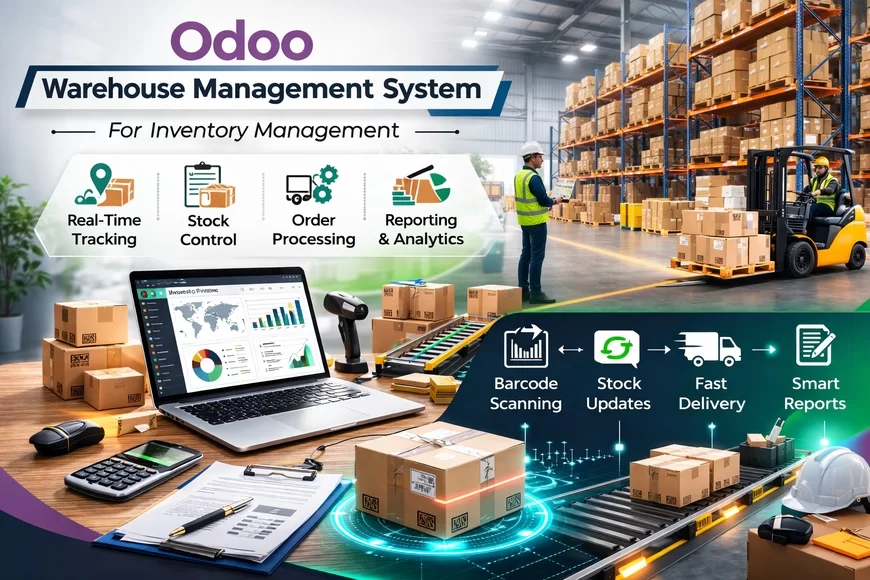
Odoo Warehouse Management System (WMS) for Manufacturing
Turn warehouse activity into controlled execution—not reactive movement
In most factories, inventory issues don’t appear as one big failure.
They surface as small inconsistencies—misplaced stock, delayed picking, unverified receipts, and mismatched quantities. Over time, these gaps create operational hesitation.
Odoo Warehouse Management transforms warehouse operations into a disciplined, traceable system—where every movement is recorded, validated, and aligned with production and delivery.
The outcome is simple: less confusion, faster flow, stronger control.
What Warehouse Control Really Means
Accuracy is not an outcome—it is a system behaviour
A controlled warehouse does not depend on experienced staff alone.
It depends on structured processes, guided actions, and enforced validation points.
What operations leaders gain
- Real-time stock visibility: know exactly what exists, where it is, and in what condition
- Controlled stock movement: every receipt, transfer, and dispatch follows a defined path
- Reduced decision friction: system-guided picking and replenishment reduce guesswork
- Operational clarity: discrepancies are visible early—not discovered late
- Traceability readiness: every movement is recorded and auditable
This creates a powerful shift:
Teams stop “checking twice” and start trusting the system.
Core Warehouse Management Capabilities
Designed to remove friction at every touchpoint
- Receiving control: validate incoming materials with structured checks and barcode scanning
- Putaway strategies: system-directed storage based on rules, capacity, or product type
- Location management: bin-level tracking across multiple warehouses and zones
- Picking operations: optimized picking routes with batch, wave, or cluster picking
- Internal transfers: controlled movement between locations, lines, or warehouses
- Stock accuracy: cycle counts and real-time adjustments with audit trails
- Dispatch validation: ensure correct items, quantities, and documentation before shipping
Each step reduces reliance on memory—and builds execution discipline.
Built for Manufacturing Environments
Where inventory is not static—it drives production
Warehouse management in manufacturing is different from trading.
It must support production continuity, material availability, and traceability.
Where Odoo WMS fits best
- Raw material and component storage
- Work-in-progress (WIP) movement tracking
- Finished goods dispatch and staging
- Multi-location and multi-warehouse environments
- High-mix, batch or serial-controlled production
The system connects directly with production—
so inventory becomes a controlled input, not a variable risk.
Connected with Manufacturing Execution
Inventory decisions affect production outcomes
Odoo Warehouse Management integrates with:
- Production planning (MRP) → ensures material availability
- Quality control → validates stock before use or dispatch
- Procurement → triggers replenishment at the right time
- Maintenance → manages spare parts availability
- Finance → supports accurate stock valuation and costing
This creates a single operational truth—
where warehouse actions directly support business performance.
Common Warehouse Problems → Controlled Outcomes
- Stock mismatches → real-time validated inventory
- Delayed picking → system-guided optimized picking
- Lost materials → location-level visibility
- Manual errors → barcode-driven execution
- Late production → material readiness through planning alignment
The system replaces uncertainty with predictable flow.
Implementation Approach (Warehouse Focus)
Stability first, speed second
- Map warehouse layout, flows, and constraints
- Define locations, routes, and movement rules
- Configure barcode and scanning workflows
- Clean and validate stock data before go-live
- Train warehouse teams using real scenarios
- Stabilise operations before scaling automation
This ensures the warehouse does not just go live—
it becomes reliable under pressure.
Warehouse Integrations
- Barcode scanners for receiving, picking, and transfers
- Label printing for product identification and traceability
- Shop-floor integration for WIP movement
- Automation workflows for alerts and approvals
The goal is not more technology—
it is less friction per transaction.
CTA-Odoo Warehouse Management System (WMS) for Manufacturing
If inventory accuracy feels uncertain, control must be designed—not assumed
- Request a warehouse-focused demo
- Identify stock accuracy gaps and movement inefficiencies
- Start with the warehouse area creating the most delays
- Book a Demo session: Contact Us
Core Odoo Service Lines
Choose the service layer that removes the most risk first
- Odoo Consulting: Define workflows, controls, KPIs, and rollout priorities: Odoo Software Consulting Services
- Odoo Implementation: Configure modules, roles, approvals, and reporting structure: Odoo Apps Implementation Services
- Odoo Customization: Extend features without destabilizing the system: Odoo Application Customization Services
- Odoo Integration: Connect data flows across business systems: Odoo Application Integration Services
- Workflow Automation: Reduce delays with controlled automation: Odoo Apps Workflow Automation Services
- Analytics and Reporting: Build KPI reporting that drives action: Odoo Apps Analytics and Reporting Services
- Support and Maintenance: Protect uptime, ad option, and controlled improvements: Odoo Apps Support and Maintenance Services
FAQs - Odoo Warehouse Management System (WMS) for Manufacturing
Q1: What is Odoo Warehouse Management System (WMS)?
A: It is a system that controls receiving, storage, picking, transfers, and dispatch with real-time visibility and traceability.
Q2: Can Odoo manage multiple warehouses and locations?
A: Yes. It supports multi-warehouse, bin-level tracking and controlled internal movements.
Q3: Does Odoo support barcode scanning?
A: Yes. Barcode workflows improve speed, accuracy, and reduce manual errors.
Q4: How does WMS support manufacturing?
A: It ensures material availability, tracks WIP movement, and supports production continuity.
Q5: What affects WMS implementation success?
A: Warehouse layout clarity, data accuracy, defined processes, and user training.