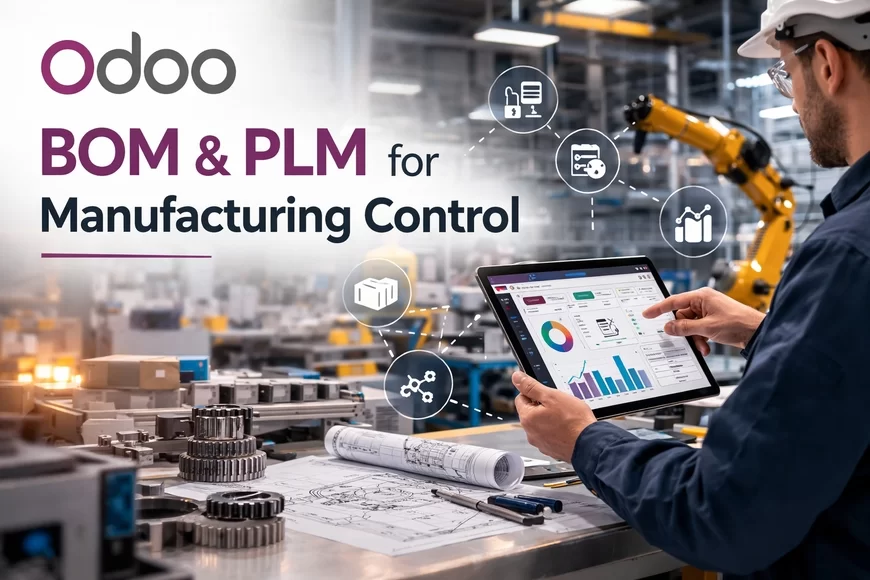
Odoo BOM & PLM for Manufacturing Control
Manage product structures, revisions, and engineering changes using Odoo BOM & PLM, helping manufacturers maintain accurate production and lifecycle control.
 RIbsadmin
Odoo BOM & PLM for Manufacturing
Bring engineering control and production clarity into the same system
In many factories, engineering and production live in separate worlds.
Design changes happen in engineering files, while production continues using outdated instructions. The result is familiar: rework, scrap, delays, and confusion on the shop floor.
Odoo Bill of Materials (BOM) and Product Lifecycle Management (PLM) close this gap.
They create a controlled environment where product design, revisions, and manufacturing instructions stay aligned.
When engineering decisions flow directly into production planning, teams stop guessing—and start executing with confidence.
Why BOM & PLM Matter in Manufacturing
A product is not just a drawing or a specification.
It is a structured system of materials, components, and processes.
Without structured BOM and lifecycle control, manufacturers face:
- Version confusion between departments
- Incorrect materials used in production
- Slow communication between engineering and production
- Rework caused by outdated instructions
- Poor traceability of design changes
Odoo solves this by building a single source of product truth.
Every product structure, revision, and engineering change is recorded and controlled—making operations predictable and auditable.
Bill of Materials (BOM): The Foundation of Production
The Bill of Materials defines everything required to produce a product.
In Odoo, BOMs can include:
- Raw materials and components
- Subassemblies and multi-level structures
- Manufacturing operations and routing steps
- Work center instructions
- Alternative components
This structure allows production planners to clearly understand what must be built, what must be purchased, and what must be assembled internally.
More importantly, it removes uncertainty.
Production teams always work from one reliable BOM structure, reducing mistakes and accelerating execution.
Multi-Level BOM for Complex Manufacturing
Many industries depend on layered assemblies—where a finished product is built from multiple subassemblies.
Odoo supports multi-level BOM structures, allowing manufacturers to:
- Break products into manageable assemblies
- Track component relationships clearly
- Plan production stages more accurately
- Control costs across product levels
This visibility helps management understand how complexity influences cost and production time.
And when complexity becomes visible, it becomes manageable.
Product Lifecycle Management (PLM): Control Change Without Chaos
Engineering change is unavoidable.
Products evolve due to:
- Quality improvements
- Supplier changes
- Cost optimisation
- Regulatory requirements
- Customer feedback
The challenge is not change itself—the challenge is managing change safely.
Odoo PLM introduces structured change control through:
- Engineering Change Orders (ECO)
- Revision tracking
- Approval workflows
- Document version management
- Collaboration between engineering and production
Every change moves through a clear review and approval process.
This prevents unverified changes from reaching the shop floor.
Revision Management That Prevents Production Errors
One of the most common manufacturing risks is using the wrong product revision.
Odoo eliminates this risk through controlled revision management.
When a design change occurs:
- A new revision is created
- Previous versions remain traceable
- Production orders automatically reference the correct revision
- Documentation stays aligned with the BOM
This protects both quality and accountability.
Supervisors know exactly which revision was used in every production run.
Engineering Change Orders (ECO)
Engineering Change Orders provide a formal way to evaluate and implement product modifications.
In Odoo, ECO workflows can include:
- Design review
- Cost impact analysis
- Quality validation
- Management approval
- Controlled deployment to production
This structured process ensures that decisions are deliberate—not reactive.
It replaces informal emails and verbal instructions with a traceable decision record.
Document and Design Collaboration
Product development depends on documents—drawings, specifications, manuals, and technical instructions.
Odoo PLM centralises these documents and connects them directly to product records.
This allows teams to:
- Access the latest drawings instantly
- Link documents to specific BOM revisions
- Track document history
- Avoid duplicate or outdated files
Engineers and production teams finally work from the same reference point.
Integrated BOM, PLM, and Production Planning
The real strength of Odoo appears when BOM and PLM integrate with the full manufacturing system.
This integration connects:
- Engineering changes
- Production orders
- Procurement planning
- Inventory availability
- Quality control
When a design revision is approved, its impact flows through the entire system.
Procurement updates.
Production updates.
Inventory planning adjusts automatically.
This prevents operational surprises and strengthens manufacturing discipline.
Practical Benefits Manufacturers Experience
Manufacturers using structured BOM and PLM processes typically see:
- Fewer production errors
- Faster product updates
- Better engineering–production collaboration
- Stronger traceability for audits
- Improved cost transparency
Most importantly, teams gain clarity.
Clarity is powerful because it reduces hesitation and improves decision speed.
When Manufacturers Usually Need BOM & PLM
BOM and PLM capabilities become critical when companies experience:
- Frequent engineering revisions
- Complex product assemblies
- Multiple production sites
- Strict compliance or documentation needs
- Growing product portfolios
At this stage, spreadsheets and disconnected tools become risky.
A controlled system becomes essential.
Implementation Approach
Successful BOM and PLM implementation focuses on discipline rather than complexity.
Typical steps include:
- Product structure analysis
- BOM standardisation
- Revision control setup
- ECO workflow configuration
- Engineering and production training
- Book a demo: Contact
The goal is not to overengineer the process.
The goal is predictable product control that supports real operations.
Strategic Value for Manufacturing Leaders
BOM and PLM systems are often underestimated.
But they quietly influence:
- product quality
- operational efficiency
- engineering productivity
- manufacturing reliability
When engineering decisions and production execution move together, manufacturers achieve something rare:
consistency at scale.
FAQs - Odoo BOM & PLM for Manufacturing
Q1: What is the difference between BOM and PLM?
BOM defines the product structure and materials, while PLM manages design changes, revisions, and engineering workflows.
Q2: Can Odoo support multi-level BOM structures?
Yes. Odoo supports complex multi-level assemblies and subassemblies.
Q3: How does Odoo manage product revisions?
Each change creates a new revision with full traceability and version history.
Q4: What is an Engineering Change Order (ECO)?
An ECO is a structured workflow used to review, approve, and implement product changes.
Q5: Do engineering changes affect production planning automatically?
Yes. Approved revisions can automatically update production and procurement processes.