Odoo For Work Order Management
Streamline production with Odoo Work Order Management. Control shop floor tasks, track operations in real time, and improve manufacturing efficiency.
 RIbsadmin
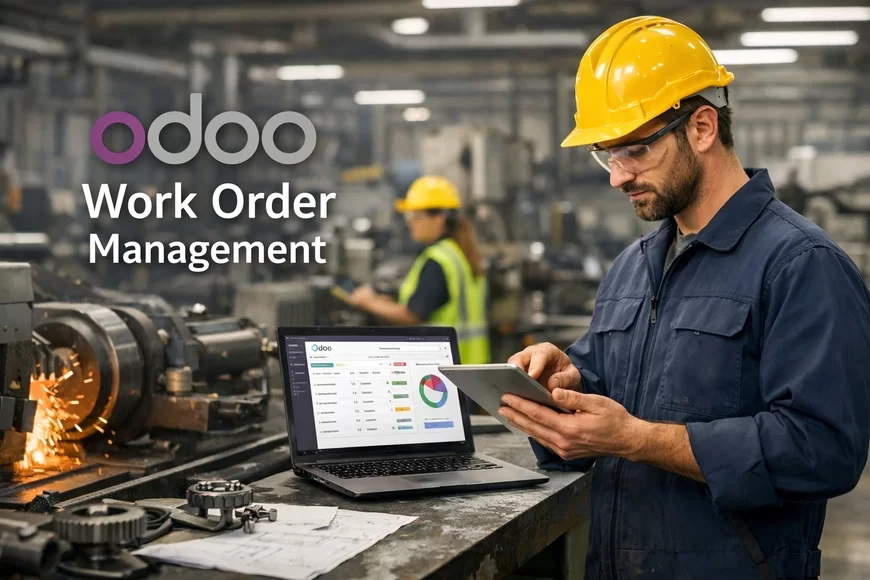
Odoo Manufacturing Work Order Management
Create clarity on the shop floor. Turn instructions into consistent execution.
In manufacturing, delays rarely start with machines.
They start with unclear instructions, disconnected teams, and invisible progress.
Work orders are the operational heartbeat of a factory.
When they are structured, traceable and visible, production becomes predictable.
Odoo Manufacturing Work Order Management brings structure to shop floor operations—ensuring every task, step and resource is coordinated in real time.
The result is simple but powerful:
operators know what to do, supervisors know what is happening, and management knows what is improving.
Why Work Order Management Matters in Manufacturing
Many factories still manage production instructions using spreadsheets, paper travellers or fragmented systems.
This creates silent risks:
• Operators interpret instructions differently
• Work progress becomes invisible
• Delays are discovered too late
• Quality deviations go unreported
• Production leaders make decisions without real data
Over time, this uncertainty compounds.
Odoo introduces discipline and transparency into production tasks, allowing work orders to guide execution step by step.
It transforms production from reactive management to controlled execution.
What Odoo Work Order Management Does
Within Odoo Manufacturing, work orders translate production orders into actionable tasks.
Each operation in a routing becomes a work order that operators execute on the shop floor.
This means production is no longer abstract planning—it becomes clear, measurable activity.
Key capabilities include:
• Structured work instructions for every operation
• Work center scheduling and task sequencing
• Real-time progress tracking
• Digital operator confirmations
• Integrated quality checkpoints
• Time and performance tracking
This structure removes ambiguity.
Operators follow a clear path, supervisors monitor progress instantly, and leadership gains reliable operational insight.
Digital Work Instructions That Reduce Errors
A common challenge on shop floors is variation in how tasks are performed.
Even experienced operators may interpret instructions differently when documentation is unclear.
Odoo solves this with digital work instructions attached to work orders.
Instructions may include:
• Step-by-step procedures
• Technical drawings
• Safety notes
• Images or videos
• Quality checkpoints
When instructions live directly inside the work order, operators execute tasks with confidence and consistency.
This reduces training time and prevents costly mistakes.
Real-Time Shop Floor Visibility
In traditional factories, supervisors often rely on manual updates or verbal communication.
This delays decision making.
Odoo changes this dynamic by providing live shop floor visibility.
Supervisors can see:
• Work orders currently in progress
• Operations waiting for resources
• Delays or bottlenecks
• Operator productivity
• Work center utilisation
This visibility triggers a powerful psychological shift.
Instead of reacting to problems after they happen, leaders intervene early and keep production flowing.
Control replaces uncertainty.
Integrated Quality and Compliance
Quality issues often emerge when production tasks move too quickly without validation.
Odoo integrates quality checkpoints directly into work orders.
Operators may be required to:
• Perform measurements
• Confirm inspection steps
• Attach quality data
• Record deviations
This ensures that quality control happens during production—not after problems appear.
For regulated industries, this also supports traceability and audit readiness.
Performance Tracking and Continuous Improvement
Manufacturers improve when they can see performance clearly.
Odoo tracks operational metrics such as:
• Actual vs planned operation time
• Work center efficiency
• Operator performance trends
• Bottleneck identification
These insights help production leaders answer critical questions:
Where is time being lost?
Which operations require process improvement?
Which machines limit throughput?
Over time, this visibility builds a culture of measured improvement instead of guesswork.
Seamless Integration With the Manufacturing Ecosystem
Work order management in Odoo connects naturally with other manufacturing functions:
• Production planning
• Inventory and material availability
• Maintenance scheduling
• Quality management
• Cost tracking
This integration ensures that work orders are never isolated tasks.
They become part of a coordinated production system.
Material shortages, machine downtime and quality checks are automatically reflected in production execution.
Psychological Impact: Clarity Drives Confidence
Factories operate best when teams feel confident in what they are doing.
Uncertainty creates hesitation.
Hesitation slows production.
Odoo work order management introduces three powerful psychological advantages:
Clarity – operators know exactly what to do.
Visibility – supervisors know what is happening.
Accountability – results are measurable.
When these three elements exist together, manufacturing teams perform with greater focus and reliability.
When Manufacturers Benefit Most
Work order management becomes critical when companies face:
• Increasing production complexity
• High product variety
• Multi-step assembly processes
• Quality compliance requirements
• Multiple work centers or shifts
In these environments, informal coordination breaks down.
A structured system becomes essential.
Odoo provides that structure—without creating unnecessary operational friction.
Work Order Management That Scales With Growth
As factories grow, coordination challenges increase.
More machines, more people and more product variants create operational pressure.
Odoo work order management scales alongside growth by maintaining:
• Standardised execution
• Real-time coordination
• Data-driven improvement
This ensures manufacturing operations remain stable, predictable and continuously improving.
FAQs For Odoo Manufacturing Work Order Management
Q1: What is work order management in manufacturing?
It organizes production tasks into structured operations executed on the shop floor.
Q2: Can operators update work orders directly?
Yes. Operators can start, pause and complete work orders using shop floor interfaces.
Q3: Does Odoo support digital work instructions?
Yes. Documents, images and step instructions can be attached to each operation.
Q4: Can quality checks be added to work orders?
Yes. Inspection steps can be integrated within operations.
Q5: Does work order data help production analysis?
Yes. Operational data supports performance and efficiency analysis.